
Each spring, the largest population of Beluga whales in Canada departs its wintering grounds in the Hudson Strait and swims southwest into Hudson Bay proper, following the coastline in a clockwise migration which leads eventually to a string of estuaries on the western shore. It’s here they spend their summers, where the Seal, Nelson and Churchill rivers empty into Hudson Bay. There are 54,000 of them, perhaps significantly more.
Maybe they come to escape the Killer whalers prowling the open Hudson, or to feed on the capelin who populate each estuary, or to give birth and moult in waters relatively warm and shallow. Whatever their reasons – and we haven’t a clue – they arrive like a force of nature from mid-June through July, turning the water in a continuous show of porcelain flesh.
That Belugas are cultural creatures, capable of passing knowledge and traditions from one generation to the next, is on display during these seasonal migrations. A newborn calf learns from her mother where their ancestors have summered and wintered for thousands of years, such that Belugas born into the Western Hudson Bay population will faithfully summer in the western Hudson Bay, even though their migratory route takes them past the estuaries of the Eastern Hudson Bay and James Bay beluga populations much sooner, populations with whom they overlap and intermingle during winter. These are learned behaviours, traditional homes, defining populations which would otherwise be indistinguishable.
My kayak was among the last to hit the Churchill River estuary in late July, 2022, the staff of Sea North Tours launching us in democratic twos and threes, but, being a strong paddler and a zealous twit, I promptly took the lead over other tourists, closing the gap between ourselves and the 4,000 Belugas who patronize Churchill at any one time, a subarctic community of northern Manitoba built on the border between boreal and tundra. You could see Belugas plainly from shore, surfacing by the dozens in every conceivable corner of the estuary, but when I cruised headlong into their domain they were suddenly absent, a peculiar quiescence which made me put down my paddle and furrow my brow.
For a moment I waited, then my kayak began to move, slowly at first and apparently under its own power, then in bucks and lurches, like I was relearning how to drive stick. I twisted in my seat to discover a pod of Belugas crowding my stern, the pure white of the adults just visible through murky brown water, the irregular greys and blues of the juveniles more obvious as they were the ones shoving me forward, pressing bulbous heads into the hard plastic of my kayak, urging me to resume the chase.
We’d been warned about the playfulness of Belugas, but until you’ve had a marine mammal just shy of two tonnes nuzzle your kayak, you cannot comprehend the potent blend of delight and terror they provoke. “Belugas like to play tag,” is how we’d been prepped of this interspecies horseplay, so I dutifully took up my paddle and recovered my momentum, whales spouting steadily in my wake. I couldn’t help but wonder if this, too, had become a cultural tradition.
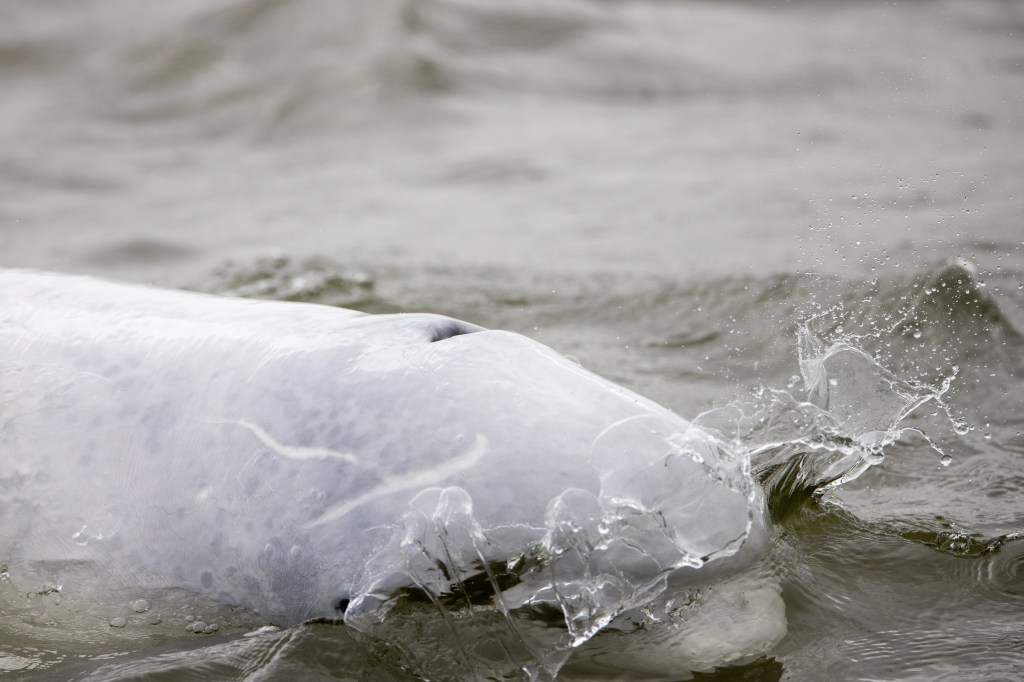
We would see a lot of these whales over the coming days, from kayak or ship or zodiac. At a distance, its easy to imagine their procession of dorsal ridges belonged to a single, massive serpent, but up close, they are a riot of individuals, swimming either as pods of males or as females and calves, the infants riding their mother’s hip so as to stay in her jetstream, the so-called “echelon position” which allows them to keep pace with the adults. And while these adults are white in the extreme, upon closer inspection their flesh is deeply grooved by a network of hieroglyphic scars, some from the random adversities of life, many from their fellow Belugas, the “raking” of teeth along their backs leaving distinctive, parallel lines.
The vertebrae of the neck are not fused in Belugas as they are in most whales, so while a Humpback must pivot its entire body to look at something in particular, Belugas merely turn their heads, swiveling their long faces to stare unambiguously at us gawking apes, perhaps asking the same questions of us as we are of them – why are you here?
Whale “Song”
When European mariners first encountered Belugas in and around the St Lawrence River of Eastern Canada (the most southerly population in the world), two features of this novel “fish” stuck out to them – the snowy whiteness of their skin, and the vocal symphonies with which they filled the water, clearly audible through wooden hulls. Thereafter, Belugas would be called the “canaries of the sea,” an enduring misnomer in sore need of correction.
Canaries (the birds) sing in the truest sense of the word, calling upon a limited repertoire of melodies to repeat ad infinitum. Even Humpbacks sing, composing and exchanging anthems throughout a season and across populations, to find mates or intimidate rivals. Belugas, however, do not sing. Belugas speak.
Valeria Vergara, co-director of the Raincoast Conservation Foundation, has studied Beluga vocalization since 2002, initially with captive whales in the Vancouver Aquarium and now in the wild – off Nunavut’s Somerset Island, along the St Lawrence River and across the Hudson Bay. She joined the same Churchill expedition as myself, hosted by local tour operator Frontiers North, and was a regular feature when we departed shore. Hydrophone in hand, she broadcast the dizzying array of chirps, clicks, claps, whistles, buzzes and shrieks occurring just beneath our boat, the ruckus melody of Beluga speech.
While we have no clue what Belugas are actually saying to one another, we’ve managed to organize their vocalizations into some broad categories. Vergara can distinguish Belugas who are fighting from those who are playing, for instance, not by understanding the substance of their dialogue, but by interpreting their disposition, like distinguishing a bar fight from a house party by eavesdropping through the wall.
The whales were not always visible from our boat, hiding a few feet beneath the translucent waters of the Churchill River, but we could hear them, dozens of them, Vergara describing their dramas with a trained ear. These ones are fighting, she would say, and those ones are employing echolocation to study the hydrophone. A pod nearby is playing, or else they’re having sex. Somewhere, a mother is looking for her calf.
Whether this cacophony can be considered a language depends entirely on how you define language. Humans employ phonemes (the smallest possible units of sound which we arrange to produce words) and syntax (the arrangement of words to produce sentences of varying meaning) in order to convey an extraordinary range of ideas. We also speak using symbolic references, to ourselves, to others, to coming storms or shifting seasons, and how each will affect the others.
“We don’t know if those attributes of human language exist in Belugas,” said Vergara, “but the more we study them and the more we discover, the more it seems that they might. [Their speech is] extraordinarily complex and I think we’re nowhere near deciphering it.”
Her career has been dedicated to one Beluga sound in particular – contact calls. These have been identified in several species of social mammal, even some birds, typically employed to maintain group cohesion, whether in a herd, flock, pod or troop.
“In Belugas,” said Vergara, “contact calls sound like a chainsaw married a rusty door.”
What seems to vary from one species to another is not the nature of the contact call – each has evolved to stand out from the background chatter of the species – but rather the call’s complexity. Sperm and Killer whales tend to remain in the same tight-knit groups for a lifetime, employing contact calls to announce their membership in a particular pod or population, but Belugas are more gregarious, moving freely from one pod to another, visiting old friends and make new ones. It’s Vergara’s contention that Beluga contact calls are more sophisticated precisely to accommodate these “fission-fusion” societies, in which strong relationships are formed between individual Belugas who do not necessarily stay together. Specifically, she believes each Beluga generates a contact call entirely unique to them, a genuine vocal signature. A name.
“They’re literally swimming around advertising their identity,” said Vergara.
True vocal signatures of this kind have only been confirmed in some dolphins, and, of course, human beings. Proving their existence among Belugas has been an exercise in perseverance, but Vergara has published a wealth of preliminary evidence to support her hypothesis and hopes to settle the matter soon, using 93 hours of recorded Beluga speech from 22 known individuals in the St Lawrence River, but those data have yet to be published.
Soundscape
Belugas are auditory creatures. In the open haze of the Arctic Ocean, where darkness reigns for six months of the year, sound is their only guide, and water conveys that sound five times more efficiently than does air, allowing Beluga adults to communicate across six kilometres of ocean under ideal conditions, their voices peaking at 150 kilohertz (humans can only hear as high as 20).
“They use echolocation and sonar to find their food,” said Vergara. “They use sound to advertise, to maintain group cohesion for moms and calves, to stay in touch with one another, to stun prey. You name it. They are a very, very sound centred species.”
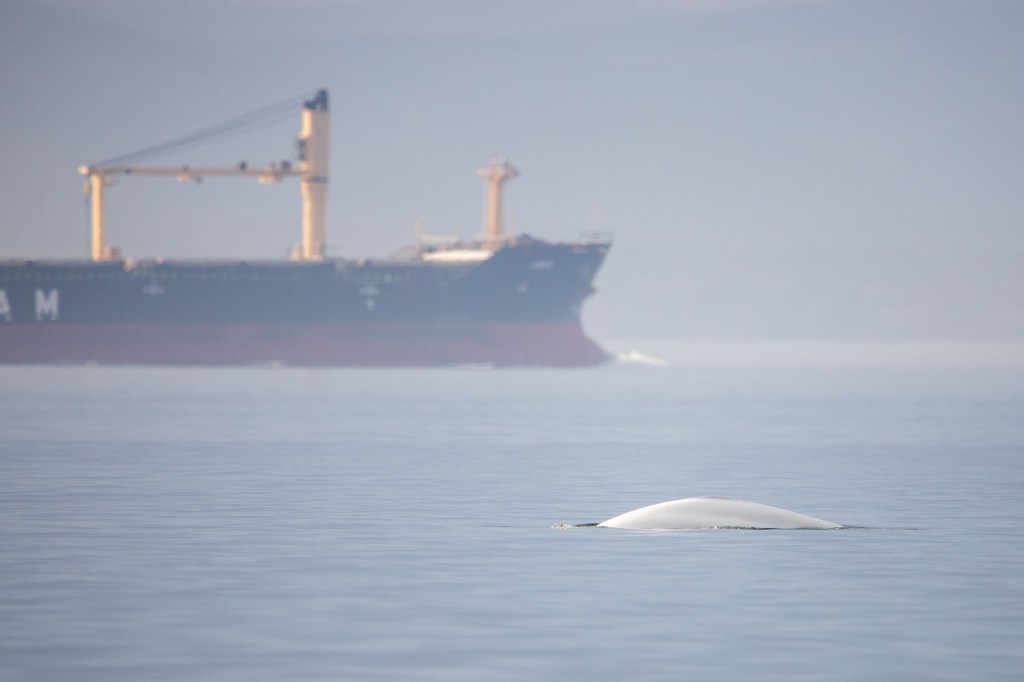
But the ocean through which they speak is getting louder. The myriad propellers of humanity are producing what researchers call “acoustic smog,” reducing the range over which Belugas can effectively communicate. Hudson Bay is still a relatively quiet place, but as the summers grow longer, and the ice less common, more shipping traffic will come, a Northwest Passage blazed by a shifting climate.
The Belugas of the St Lawrence River, far to the southeast, already suffer extremes of acoustic fog, and so offer a disquieting preview. Vergara has studied this population since 2008, and demonstrated the range of their calls is roughly halved in the presence of ship traffic. For adults, this is challenging, but for newborn calves, it may be fatal. Their developing voices carry just 360 metres under ideal conditions, a range which acoustic fog can reduce to 170 metres. It’s not difficult, said Vergara, for an infant to stray 170 metres from its mother, which may explain the alarming number of dead calves washing ashore in the St Lawrence River.
Solutions abound for acoustic fog. Ships can slow down or avoid Beluga hotspots at key times of year, two strategies presently employed in the St Lawrence River, and noise reduction technologies do exist, even specialty propellers which do away with spinning blades. Alternatives cost money, but could soften the blow of acoustic fog before it inevitably strays into Hudson Bay, with untold consequences for the robust migratory culture of our largest living population.
The Social Mammal
Our final day on the water was via zodiac, our small craft promptly swarmed by pods of boisterous males, their bodies long and wide, gliding beneath and around us, emitting deep, foghorn moans. And while they were splendid, their female counterparts, who we joined shortly thereafter, were by far the most interesting.
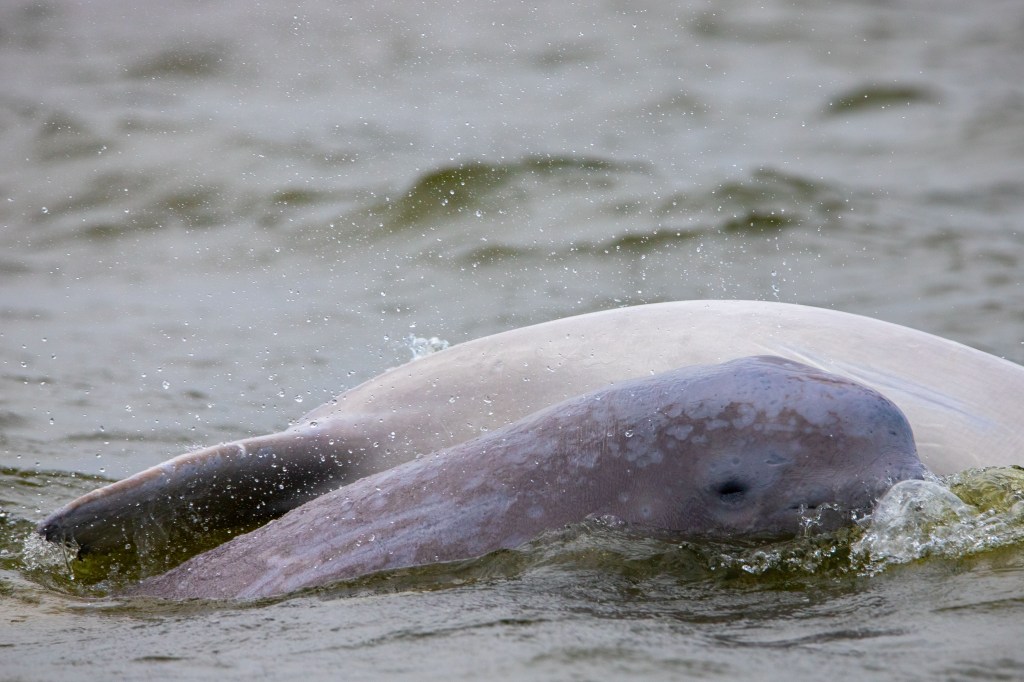
Beluga females are cooperative in the extreme, sharing the responsibility of childcare so completely that researchers struggle to pair calves with their biological mothers. Females will nudge unrelated calves back into formation if they go astray, provide them a jetstream in which to swim, hoist them above water so they can catch their breath, even spontaneously lactate to give them milk. Female Belugas undergo menopause, a sure sign of prolonged social utility.
Vergara has seen Beluga “kindergartens,” in which younger females watch over several dozen rambunctious infants while their biological mothers are otherwise engaged. She’s also witnessed groups of females take turns to comfort a frightened calf, wrapping their tails around the tiny creature until its cries subsided.
Some of this was on display in the Churchill River, especially when we killed our engines in the path of a pod, allowing its members to overtake us in a disorienting chorus of spouts. Infants were unmistakable in the crowd, excessively smooth but for the occasional role of superficial fat, their faces expressionless, their visits to the surface enthusiastic and sudden, punctuated by the sharp rise of their chins. One infant in particular thrusting her head above the water immediately adjacent to our zodiac, her attending adult surfacing alongside. This infant lingered a long while, staring at us in abject curiosity, her mouth slightly agape. She captured my imagination on the instant, and never quite let go.
She looked to be brand new, which means she’ll spend the next two years learning the speech of her elders, and that she’ll soon be undertaking the autumn migration to the Hudson Strait for the very first time. Whether she’ll turn east and depart Hudson Bay counterclockwise or turn north, swimming first up the western shore and departing through Roes Welcome Sound, between the Nunavut mainland and Southampton Island, we can’t yet say.
If life is fair, this infant will outlive me, as Beluga lifespans are comparable to our own. She will also live through every climatic and acoustic tweak we make to her Arctic home, dialing up its decibels in tandem with its temperature. I can only hope the cultural, cognitive and communicative tools she’s inherited are enough to adapt to a changing world, and that we Canadians have the forethought to meet her halfway, preserving an Arctic in which Belugas may babel.
Zack Metcalfe is a freelance journalist, columnist and author based in Salmon Arm, BC. A version of this article was originally published with Canadian Wildlife Magazine.



 The Wandering Rook
Leave a comment