
It must have been six in the morning. It was hot, and the smoke of distant Quebec wildfires was mingling with the natural mists of the St Lawrence River surrounding my small island, Île-aux-Lièvres, on all sides. This island – a 13 kilometre dagger immediately northwest of Rivière-du-Loup – was then battered by rough wind and waves, just as I had hoped.
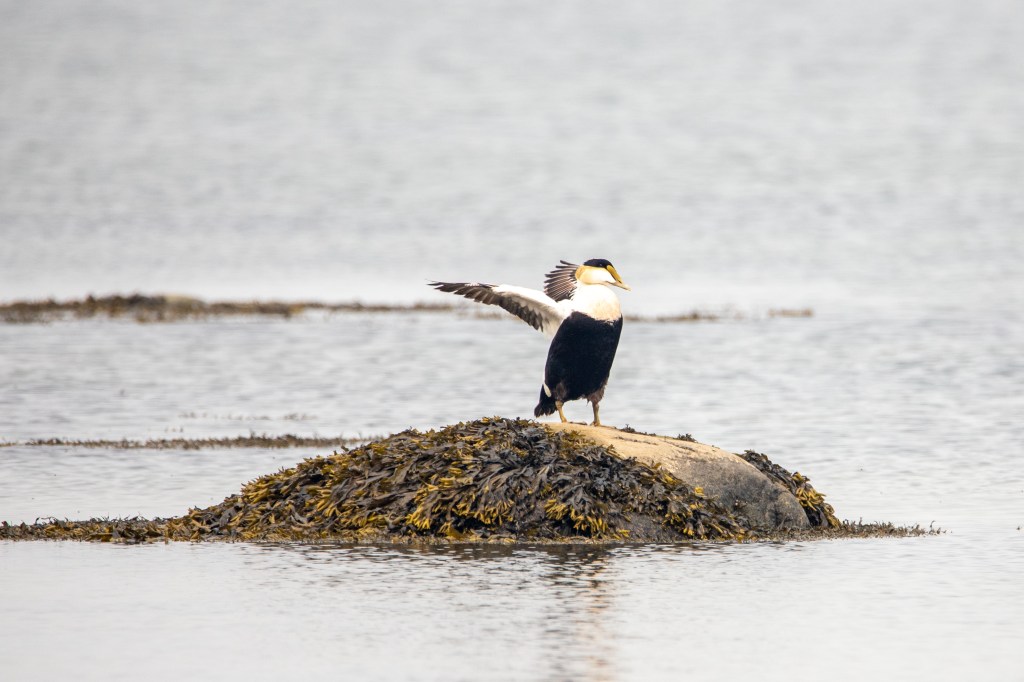
The Common eider, a seabird, is easily the most skittish creature I’ve ever attempted to photograph. Even breaching Humpbacks give you a quarter second to line up your shot, but not eiders. Walking the shores of Île-aux-Lièvres, and before that Les îles du Pot à l’Eau-de-Vie (a tiny cluster of islands nearby), I saw eiders modifying their behaviour hundreds of metres away, avoiding me in wide arcs like I was the American Sniper.
I can’t blame them. Seabirds, while exquisitely adapted to life on the ocean, are famously defenceless when coming ashore, which they must do for an anxious few months every year to lay their eggs. This is why they nest on islands, where there are few if any meddlesome mammals waiting for them, like rats, racoons and foxes. And photographers.
That morning I was determined. The weather was bad, and the birds were hugging the island for shelter, so I approached a sleepy cove at first light with extreme caution, and over the howling wind and beyond the bushes lining the shore, I could hear a flotilla of eiders, a cacophony of quacks in the gentler pools of water behind a windbreak of rock. Then, all at once, I heard them take off.
I can’t imagine how they heard me, but when I finally rounded the bushes there were about 200 of them on the wing, putting an extra 50 metres between themselves and shore, and landing in the relatively rough waters beyond the windbreak. Once again, the skittishness of the Common eider left me astonished. I hadn’t made a sound, and I hadn’t stepped into view. I’d hardy gotten close enough to know they were there.
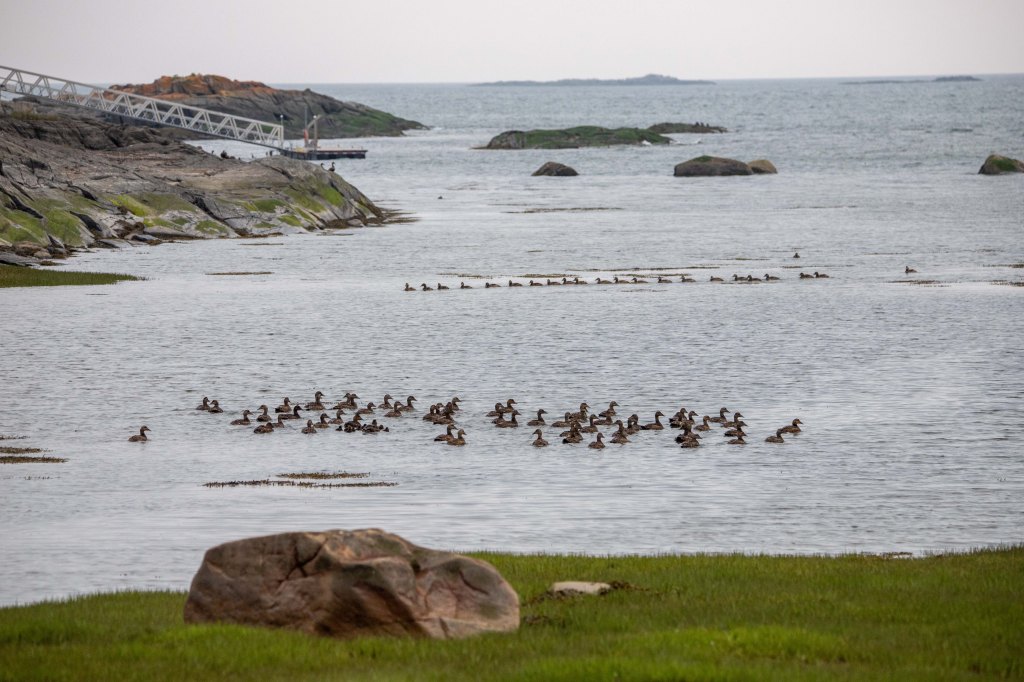
But as the seconds wore on, and I studied the evacuated cove in the weak light of an overcast morning, my stomach dropped, and my astonishment turned to horror. In their haste to leave, this flock of eiders had abandoned three small chicks, still too young to fly with their parents, and apparently forgotten in the mass exodus. There they were, three infant eiders, paddling at a feverish pace to rejoin the flock, chirping in frightened unison. They were rounding the windbreak sheltering the cove, and perched on that windbreak was a trio of gulls.
Société Duvetnor is a charitable non-profit established in 1979 by Jean Bédard, a biologist who, at that time, was studying the seabirds of “The Eider Islands,” as they’re sometimes called, Île-aux-Lièvres and Les îles du Pot à l’Eau-de-Vie among them. These islands, peppering the St Lawrence River and concentrated near Rivière-du-Loup, support 30,000-40,000 pairs of nesting eiders annually, the single largest colony in Atlantic Canada, outstripping all the Maritime provinces combined. The mission of Société Duvetnor was to protect as many of these dozen or so islands as possible on behalf of seabirds, either by purchasing them directly or by having their partners – the Canadian Wildlife Service and Government of Quebec in particular – convert them into parks and sanctuaries.
And they were largely successful, safeguarding Les Pèlerins to the south, Récif de l’Île aux Fraises to the west, Île Blanche to the north, Îles du Pot à l’Eau-de-Vie to the east and Île-aux-Lièvres right in the middle, preserving the nesting grounds of tens of thousands of Common eiders from cottage development, from a proposed natural gas terminal, and from any “cowboys” who might help themselves to these islands and their seabirds.
People are a problem, said Bédard. If spooked by even the most respectful human being, adult eiders might abandon their chicks, and seconds without supervision leaves them at the mercy of waiting gulls, birds both predatory and overpopulated from feeding on human trash. In my time on these islands, I saw several gulls make brazen attempts to snatch away eider chicks, their efforts foiled only by the combined counterattacks of several dozen adult eiders. Accidentally scare those adults away, even for a moment, and you’ve given gulls an opportunity they aren’t likely to miss.
The instant I realized my mistake on that stormy morning on Île-aux-Lièvres, I dove back behind the bushes, cursing my own stupidity, and waited, stiff, for those three chirping chicks to rejoin the flock. At first, the gulls did nothing, staring at the passing chicks with tilted heads and closed mouths, but then, one of them dove. At the same moment, a lone eider peeled away from the flock and threw herself at the attacking gull, the two colliding inches over the heads of the chicks. The violence that followed was more than I was prepared to see.
My view was poor, through the leaves of my chosen bush, but when the attacking gull was finally expelled, one of the chicks was missing, and the adult eider gathered the two survivors for a hasty escort back to the flock. Just when they seemed home free, a massive gull planted itself in their way, herding the lone eider and two chicks back toward the sheltered cove. More gulls came, and the lone eider began a desperate leaping, back and forth, to repel the multiple attacks, but it was hopeless. The chicks were gone in seconds.
I was sick with guilt for the next several days. It’s rare that any of us are confronted so immediately and unambiguously with the consequences of our actions. You don’t see an icecap fracture the moment you hop into an 8 cylinder SUV, or a chunk of the Amazon tumble when you bite into a cheeseburger. That gang of gulls might have been a lot smaller had fewer people thrown stale french-fries into the open dumpster outside MacDonald’s, but those same gulls wouldn’t have had their chance without my early morning hike, my rounding of that coastal bush, my pursuit of a better angle. I was the harbinger of death in hemp socks, and even with an abundance of caution and benign intentions, I got those chicks killed.
La Cuisine
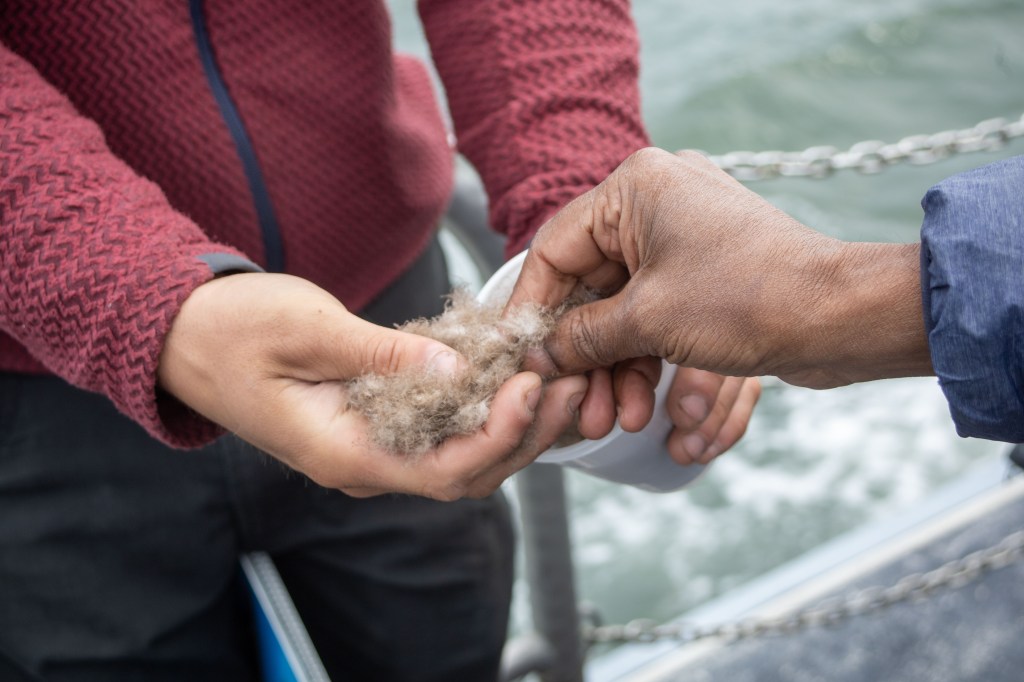
Société Duvetnor is an unusual organization. It doesn’t conserve these islands on behalf of eiders. It conserve these islands in partnership with eiders. Their arrangement boils down to a trick of biology. An eider’s feathers, commonly called “eiderdown,” is so profoundly insulating that adults struggle to warm their eggs. Body heat simply can’t escape their feathery yokes. The solution is obvious, if a bit crude – adults rip out their own feathers, pocking enough holes in their downy breasts for heat to escape and keep their eggs toasty. They line their nests with their discarded feathers, and while of minimal value to parent and chick, eiderdown is of enormous value to Société Duvetnor. About $1,500 a kilogram.
In the 1980s, when it came time to buy these islands, Société Duvetnor needed partners and donors to take them seriously. For this, they needed income, and there it was, lying on the periphery of tens of thousands of nests. The extraordinary properties of eiderdown – as warm and soft as a beam of summer sunlight – combined with its relative scarcity on the global market, makes for a tidy income, provided you can collect, clean, package and market relevant sums to wholesalers in Germany and Japan, a process requiring mountains of equipment and expertise.
Then there’s the issue of killing chicks, typically by frightening off the parents. In the decades before Société Duvetnor’s purchase of these islands, the uncoordinated harvest of eiderdown by locals was a serious issue, and no small part of the organization’s outreach has been focused on this sticking point of biology. Approaching eiders willy-nilly has consequences, as I learned on that early morning in June. But how, then, was Société Duvetnor to harvest eiderdown themselves, in order to purchase these islands in the first place and maintain them thereafter?
The organization was founded by biologists, Bédard being one of several, so together they developed a biologically sound harvesting technique. Their collectors pass over each of Société Duvetnor’s islands in a line, and when a nest is located, no more than half its eiderdown is taken, the rest being draped overtop the delicate eggs, along with bits of dry grass to hide the nest from gulls until the roosting eider returns. Timing is everything. Collect too early and eiders aren’t established enough to yield much down. Collect too late, and you’re putting hatched chicks at risk of abandonment. Collections, therefore, occur across every island in a marathon harvest just before eggs are due to hatch, a biological sweet spot in which there’s plenty of down and no chicks. In this way, Société Duvetnor has been able to afford the islands under its care without measurably harming its resident eiders, while also collecting a wealth of data about the population at large. And so it is, that eiders pay rent with discarded feathers.
Not all have been banner years, however. Société Duvetnor’s best collections peak around 125 kilograms, said Bédard, but when the eiders are hit with disease, as in 1975, 1985 and 2022 (this last by avian flu), sizeable fractions of the population can disappear overnight, and collections crash in tandem.
Then there are foxes. Every now and again, these small predators cross winter ice and become marooned on one or more of The Eider Islands, obliterating any and all seabirds who dare to come ashore. Société Duvetnor tries to trap them ahead of the nesting season, but if they fail, entire islands worth of birds cannot breed, and the foxes themselves tend to starve the following winter. The result of fox infestation is that vanishingly few chicks are hatched, and no eiderdown is collected.
It was extraordinary to me, while staying at the Société Duvetnor inn on Îles du Pot à l’Eau-de-Vie (a renovated lighthouse), just how destructive foxes could be. Two islands in this small archipelago – connected at low tide – housed no seabirds, the eiders, murres, guillemots and razorbills which should have been nesting there instead floating offshore by the thousands, unwilling to risk an encounter with the foxes who’d arrived the previous winter. When I asked a staff member how many foxes had done this, spoiling the reproductive success of thousands of displaced seabirds for the year, she held up three fingers – a mother fox, and her two cubs.
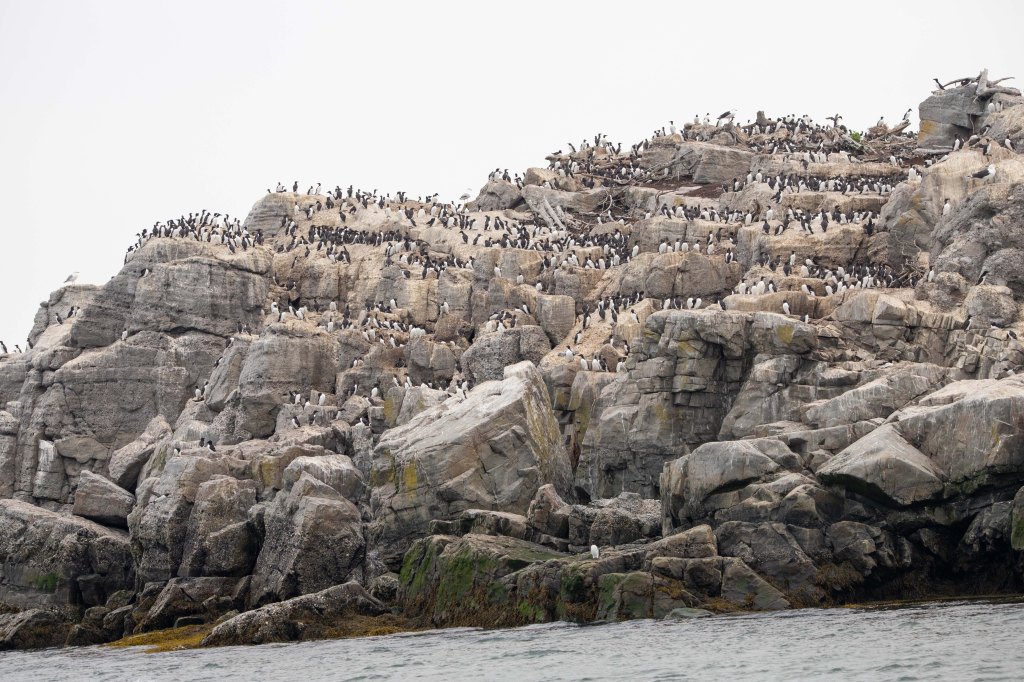
The third island of Îles du Pot à l’Eau-de-Vie, called Le Petit Pot, couldn’t be reached at low tide and was thus immune to this family of foxes. The difference was profound. Every square centimetre of its bald, granite scalp was claimed by one seabird or another. They were as thick as grass, and from dawn until dusk, Le Petit Pot shrieked with birdsong. Even from Île-aux-Lièvres, not an insignificant distance away, the sound rang true, like an army of roosters marking each and every morning. By keeping these islands as intact as possible, Société Duvetnor is also keeping them loud, a wild chorus as thrilling as it is heartening.
Société Duvetnor is also strange for its style of ecotourism. Besides the lighthouse on Îles du Pot à l’Eau-de-Vie, all of this visitation is reserved for Île-aux-Lièvres (the rest of The Eiders Islands are closed to the public). Being the largest of these islands, Île-aux-Lièvres it is also the most prone to foxes, and sure enough, during my visit there was a pack of their prowling the forest, their carnage routinely visible. If you’re going to choose an ecosystem to disturb with gentle tourism – Société Duvetnor’s second source of income – why not the island already disturbed by ravenous foxes? It’s here, on Île-aux-Lièvres, that people can see and appreciate these seabirds without posing any serious risk to the population at large.
While camping is permitted (and very popular) on Île-aux-Lièvres, the organization’s mainstay is a tiny village built by the wharf, with downright luxurious rooms, a café on the water, and a restaurant serving three to five course meals. It’s especially impressive when you consider all food and water must be boated in from Rivière-du-Loup, and all power and heat must be produced on site by generator or solar panel.
And the food. The culinary experience of travelling vegans is usually some version of “shut up and eat your quinoa!” but hearing of my dietary restrictions, the kitchen of Société Duvetnor invented a new menu for its very first vegan guest, with some of the finest plant-based meals I’ve ever eaten. Then, after serving me this bounty with a smile and “bon appétit!” I was thanked by the chefs for providing them such an interesting challenge. I was expecting cold nights in my tent and garden salads without dressing, not a king sized mattress and vegan baklava.
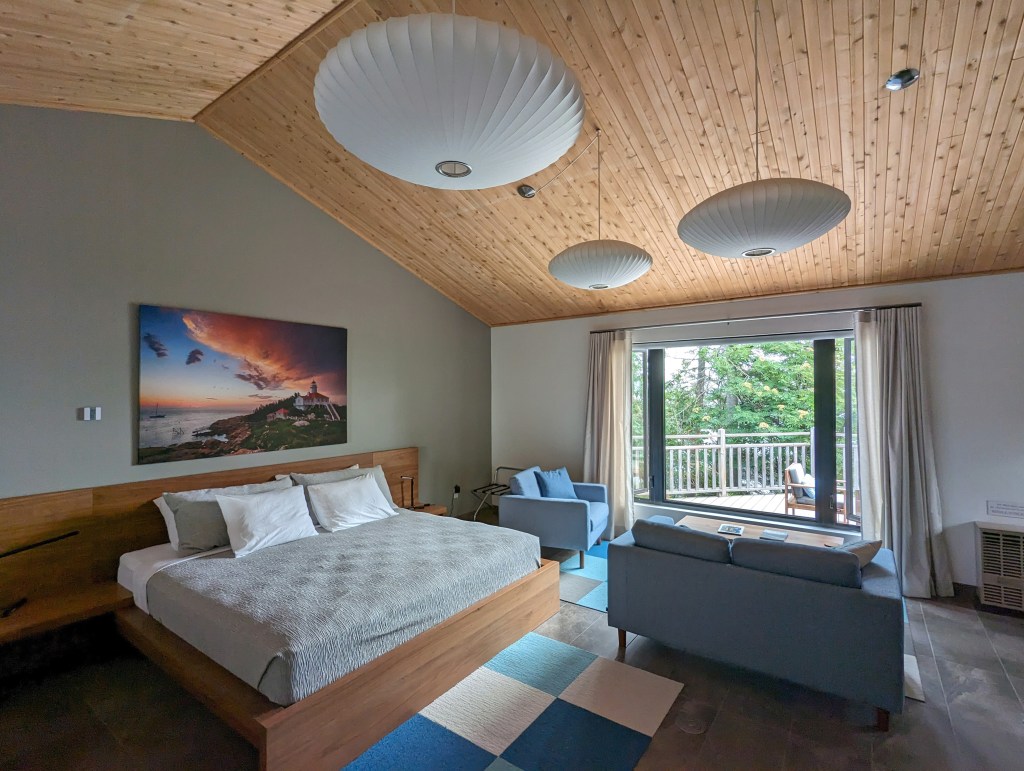
Bonaventure
My head still spinning from the hospitality of Société Duvetnor, and my heart still throbbing for those three chicks, I departed Île-aux-Lièvres in the last week of June and travelled downstream, following the St Lawrence River until it became the St Lawrence Gulf, at the very tip of the Gaspé Peninsula. I caught a ferry in Percé, Quebec, sailing southeast to Île Bonaventure.
At one time Bonaventure supported a fishing village, but the province took possession in 1971, and in 1985 converted the island into a parc national. From the water, it looks downright primeval, with sheer cliffs assuming strange shapes as they climb, climb, climb from a broiling sea into the fog. And while it was summer in earnest, I convinced myself these cliffs were still covered in snow, several dozen ribbons of white cutting horizontally across their faces, and the glare of icecaps coming from their peaks. It took me a moment to see, and then to believe, that these ribbons and icecaps weren’t snow, but birds.
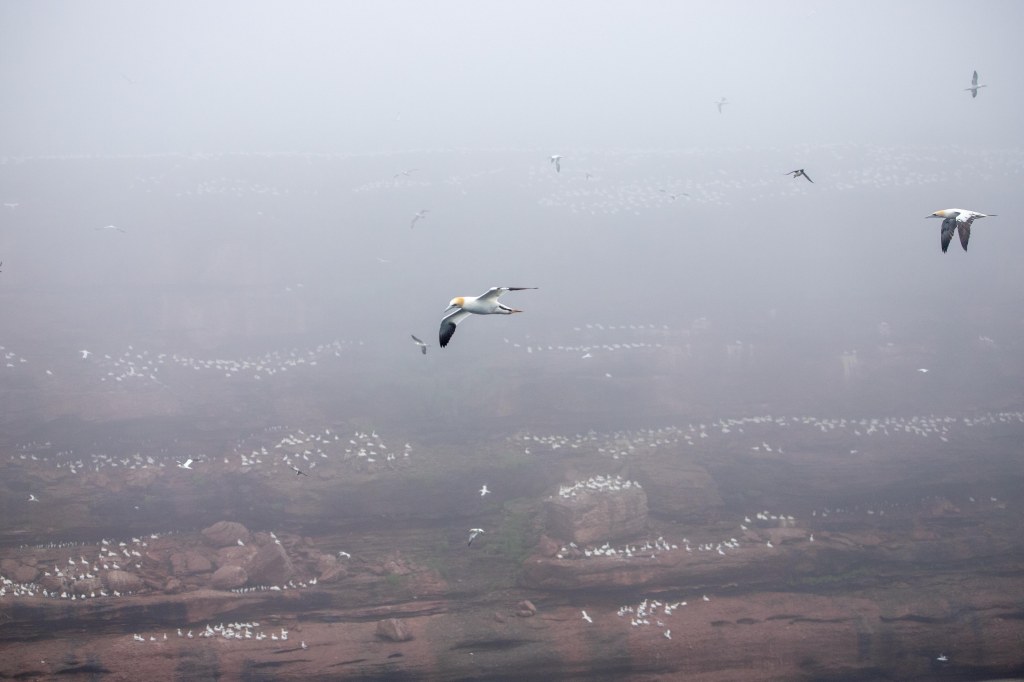
Bonaventure supports the largest breeding colony of Northern gannets on the planet, as many as 55,000 pairs every year. If you’ve ever seen a gannet, with their splendid white bodies, golden crowns and striking blue eyes, perhaps you can imagine the snowy deception produced by 110,000 of them. In fact the gannets crossing your path in New Brunswick, Nova Scotia or PEI were probably born on Bonaventure.
These cliffs offered no safe harbour, so our ferry docked on the island’s far side, where a few historic buildings have been repurposed for the benefit of visitors, to share the history of the island and its people. My schedule was such that I missed it all, marching immediately back across the island to admire the seabird colony on foot and from above, rather than from our ferry far below.
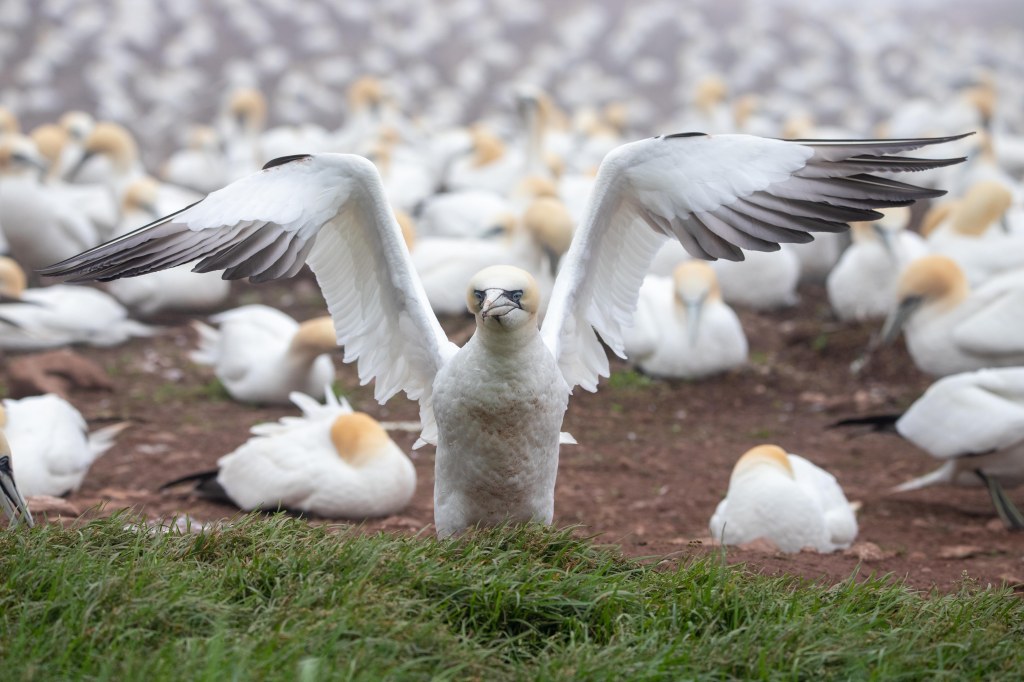
What I found was a bird very different from the Common eider. Gannets are big, and when they’ve extended their wings and puffed out their chests, they give the impression of an angry swan, not even mildly intimidated by human beings. The colony, lining the rim of the cliffs, was a pungent, deafening brawl, tens of thousands of spiteful birds marking the territory around their nest with a succession of hisses, honks and bites, a dozen or more locked in combat wherever you care to look. They are a beautiful species, their plumage and build a testament to evolutionary grace, but they can put up a fight like no seabird I’ve ever seen, and I pity the gull, fox or cowboy who strays into this pit of vipers, especially where chicks are concerned, floppy, helpless critters poking bills out from beneath their warring parents.
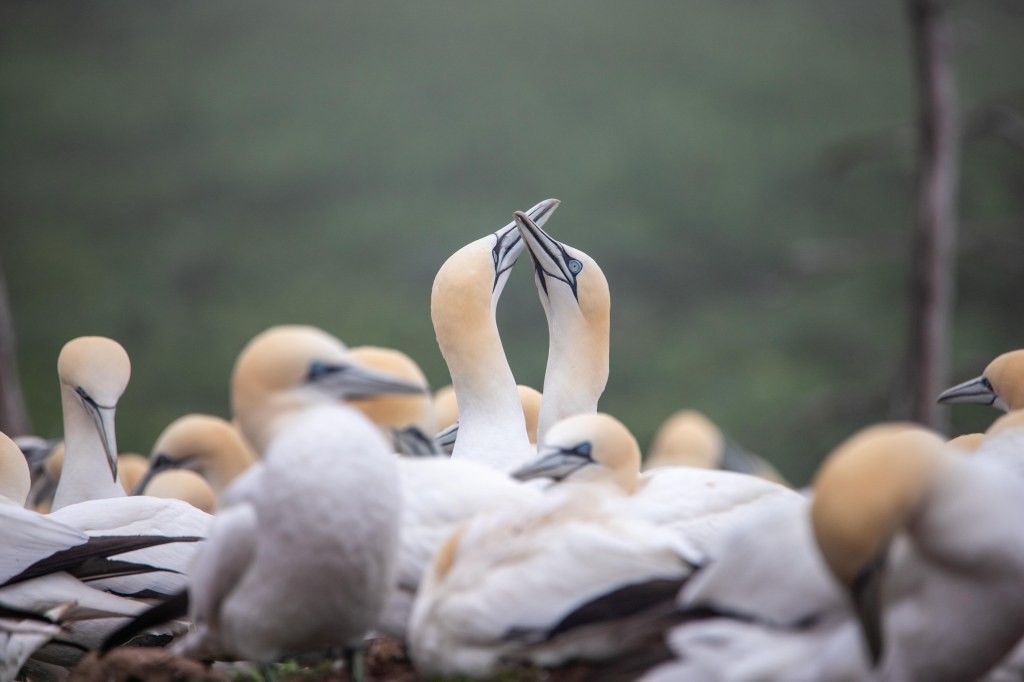
I’ve written enough about seabirds to know you cannot distinguish between them and their islands. Where one falls, so does the other. Seabirds need islands with few if any predators on which to breed, because eggs do not float, and islands need birds for the nutrients deposited in their droppings, lest they bleed their topsoil into surrounding water with no means of replenishing it. Seeing the might of island/bird partnerships, and how easily those partnerships are disturbed, makes me wish we’d conserve the small islands of the Maritimes with a fervour similar to eastern Quebec. Nova Scotia’s coastal islands in particular once housed some of the largest seabird colonies on the planet, islands which today host imported mammalian predators like rats and dogs, feral livestock like sheep and horses, and cottaging Homo sapiens, all with a fraction of their former seabirds. If Bonaventure, or The Eider Islands, were cleared for cottages, or natural gas terminals, or agriculture, or given to imported predators and livestock, the number of Northern gannets and Common eiders in Atlantic Canada would drop perceptibly, even catastrophically. It should be humbling, that so many birds depend on so little rock.
Zack Metcalfe is a freelance journalist, columnist, and author based in Salmon Arm, BC. This article was originally published with Your Local Magazine.



 The Wandering Rook
Leave a comment