
Black Tickle, on the Island of Ponds, Labrador, is one of 258 “remote communities” recognized by the Canadian federal government. It has no connection to a provincial electrical grid, no roads joining it to neighbouring communities, and 85 residents in need of electricity and heat.
Communities of this kind have some of the largest per capita carbon footprints in Canada, because they’re unable to participate in the hydroelectric, wind, solar, tidal and nuclear power supplying the vast majority of the Canadian electrical grid, and must produce their own using diesel generators the size of school buses, at an unsubsidized cost of $1.30 per kilowatt. When you tally up the diesel for electricity, the furnace oil for heat and the gasoline for transportation, Canada’s remote communities require about a billion litres of fuel each year.
Nick Mercer, a community based energy efficiency scholar and assistant professor with the University of PEI’s Island Studies Program, has spent much of the last decade examining the energy needs of the remote communities of Labrador, and how best to transition those communities to more affordable and carbon efficient sources of power. His findings have been illuminating not only for Black Tickle and its neighbours, but also for regions farther south.
Diesel generation comes at enormous cost, said Mercer, not only for the remote community in question but for the relevant provincial or territorial government subsidizing its delivery, typically by boat or plane. This cost is also borne through carbon emissions, fuel spills and noise. In the course of qualitative interviews with residents of Labrador’s remote communities, however, Mercer found that diesel enjoys a great deal of local support, sometimes over and above renewables.
“Renewable sources of energy – wind turbines, solar panels, small modular nuclear reactors – these things are increasingly promoted to improve the sustainability of these isolated communities and villages, however, my research and the research of other scholars has indicated that, in the absence of legitimate processes of local ownership of these projects, local control over the projects, local engagement, these projects can create enormous tensions. Renewable energies are not always perfect.”
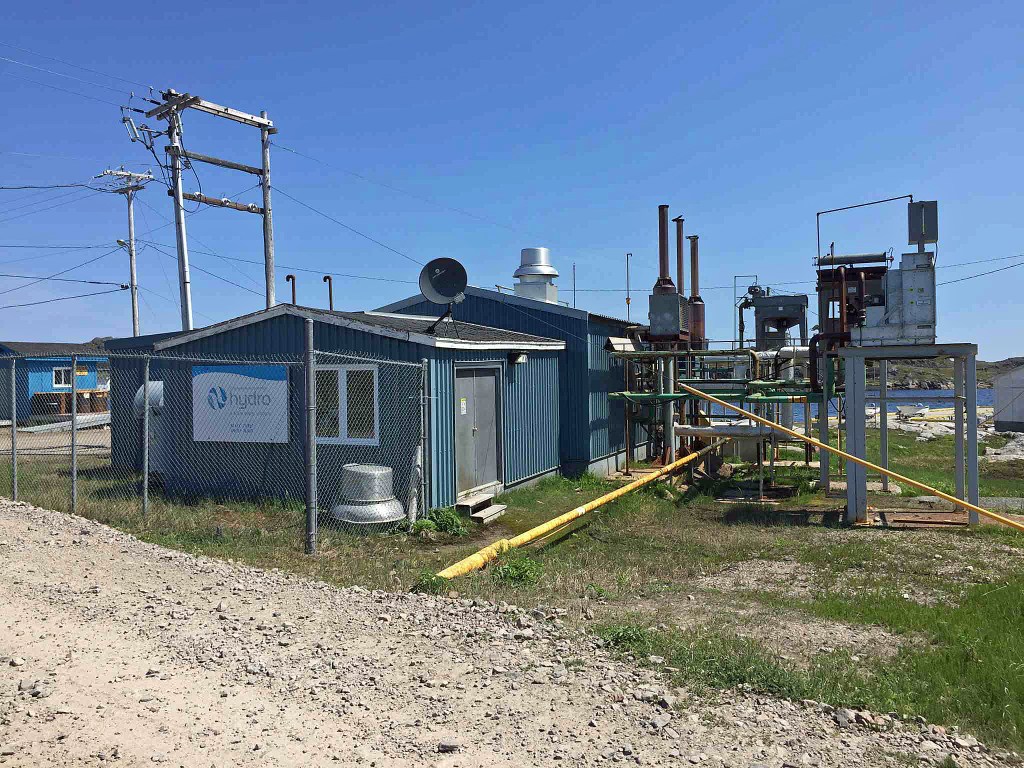
And these imperfections take many forms. One is misalignment – when an energy project doesn’t meet the community’s most pressing needs. In the remote communities of eastern Labrador, for example, the most pressing need is for clean, reliable and affordable home heating, which must come from either furnace oil or firewood, given the scarcity of electricity and the fragility of local infrastructure. In Black Tickle, furnace oil can only be purchased in the neighbouring community of Cartwright, 90 kilometres away by skidoo (180 kilometres round trip), and firewood can only be gotten on the Labrador mainland by crossing sea ice in winter, ice which has gotten perilously thin in recent decades. A new wind farm, therefore, does nothing for inadequately heated homes.
Another drawback is that, if executed incorrectly, renewables can erode a community’s self-sufficiency. When the communities themselves own the renewable project, they become less reliant on imported power, generate electricity which they themselves can sell, and earn some degree of self-determination. If the renewable project is owned instead by a government, corporation or utility, all these benefits tend to go elsewhere, while the administrative burden, and the inherent risks of novel technologies (such as small modular nuclear), stay with the community.
“We need to move toward this concept of energy sovereignty,” said Mercer. “I define energy sovereignty simply as the inherent right of these communities, especially indigenous communities, to choose energy systems which can operate entirely in the absence of external control, support or import.”
Mercer’s qualitative interviews with residents of remote Labrador allowed him to build the CARES framework, listing the five factors which influence community support for any given energy project. The first is community familiarity, a factor which gave diesel a commanding lead, as it has provided relatively reliable electricity to places like Black Tickle for decades. It also benefitted solar, as seasonal hunting and logging camps routinely employ solar panels.
“Electricity is a matter of survival in the north,” said Mercer. “There’s definitely an attitude in the community of don’t fix what ain’t broke. People support what they understand.”
Another factor is a project’s association with ones that came before. The people of Black Tickle are generally opposed to micro or pico hydroelectricity because they associate these technologies with the controversial Muskrat Falls Generation Facility. The third factor is a project’s impact on community resources, like fishing and gathering grounds, and the fourth is endogeneity – how local is the power source? There’s plenty of wind in Black Tickle, but very little uranium. The fifth and final factor is security.
“[Security encompasses] all the benefits of renewable energy projects that developers often cite – economics, health, reliability – but we found in our research that none of that matters if you can’t maintain [the other four factors]. You can’t skip over these important cultural implications of energy systems in the name of energy security.”

After obeying this framework, and paying heed to energy sovereignty, the renewable which won the day in Black Tickle wasn’t renewable at all. In 2022, Mercer helped establish the High Efficiency Wood Stove Pilot Project, in which high efficiency woodstoves, certified by the EPA, were installed in 14 homes. These woodstoves emit as much as 96 per cent less particulate matter per hour when compared to conventional woodstoves, and convert firewood into heat 33-50 per cent more efficiently, dramatically reducing the amount of wood that needs gathered each season. In order to be insured, these woodstoves had to be installed by Wood Energy Technology Transfer (WETT) certified contractors, whom the pilot project needed to recruit from elsewhere, but while in Black Tickle, these contractors trained locals, beginning their certification process. When this project expands to other remote communities in eastern Labrador, people from Black Tickle will be able to do the installing.
Mercer is especially proud of this project, because it reduces Black Tickle’s carbon emissions (furnace oil, gasoline for wood collection, etc.) while delivering savings directly to households, addressing their most pressing energy needs, and embedding the skills necessary to install and maintain these woodstoves locally.
“If you’re a household in Black Tickle reliant exclusively on wood, burning ten cords in the harsh Labrador winter, one of these stoves will cut you down to anywhere between 5-6.5 cords. That’s a tonnes less labour, a tonne less time spent on the land, a tonne less gasoline spent driving back and forth from the mainland, a tonne less time spent on untrustworthy sea ice. We’re hoping these stoves make a major difference in the lives of community members.”
One Island to Another
Prince Edward Island is in the midst of its own energy transition, committing, by way of its Net Zero Framework, to achieving “net zero emissions” by 2040. In practice, this means the electrification of home heating and transportation, a ubiquity of renewable power both domestic and imported, and that any remaining emissions, from nitrogen fertilizers, say, would be offset by equivalent carbon sequestration projects, such as reforestation. It is arguably the most ambitious emissions reduction target in Canada.
Nick Mercer is new to PEI, and cautions that Black Tickle is a very different place with very different challenges, but the shortcomings of renewable power, and the CARES framework for community acceptance of renewable projects, helps him approach PEI’s progress with a critical eye.
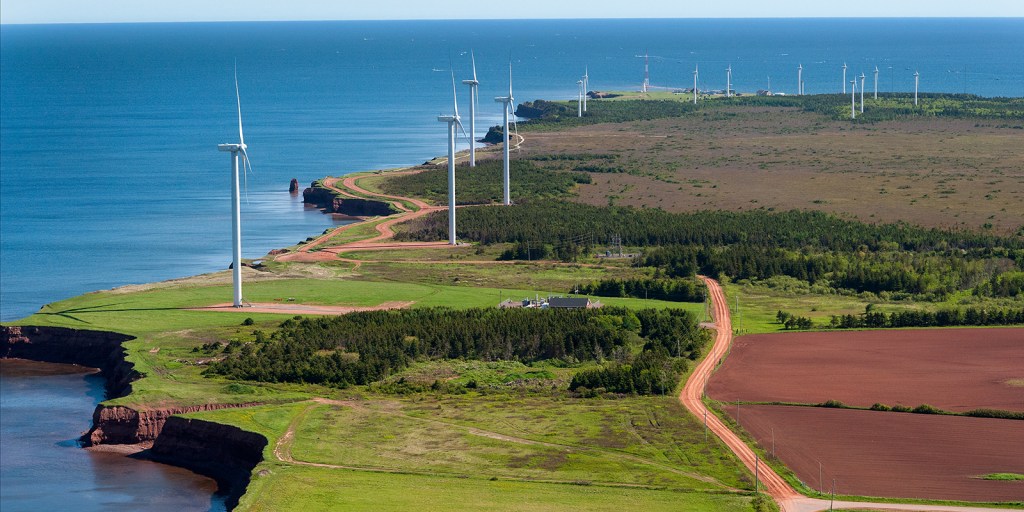
As in Black Tickle, the low hanging fruit on PEI is energy efficiency, he said, which the province is addressing with rebates on highly efficient electric hot water heats, LED light bulbs, home insulation and heat pump, this last available for free to qualifying low-income households. Not only do these rebates achieve energy efficiency, with a corresponding drop in carbon emissions, but the financial benefits are entirely and immediately felt in participating households.
“Oftentimes we seek out these fancy technological solutions instead of just using less,” said Mercer.
However, the cornerstone of this rebate program – free heat pumps – exposes Islanders to the risks of novel technology, which, in this case, manifests as a lack of local tradespeople able to fix them, and a lack of local businesses able to recycle them. Heat pumps are arriving in force, without the human resources necessary to maintain them.
“To draw a parallel to the work I did in the north,” said Mercer, “there have been several experiments across the territory where wind turbines have been put up, then, within years, they’re left not turning because no one is able to fix them [locally]. So, if you’re using a local resource, like the wind, but then you don’t have the human resource available to fix, maintain, upgrade, troubleshoot or respect the warranty of these technologies, then you find yourself dependent on expertise from the south.”
Prince Edward Island is enjoying a boom in rooftop solar installation, driven in part by 0% financing programs, in which Islanders pay for installed solar at roughly the rate that solar saves them money. While these rooftop arrays supply home and grid with renewable power, Mercer offers another cautionary example from the north. In remote communities he’s worked with, local electrical grids are maintained by relatively few households, maybe a few dozen. Every household pays to extract power from the grid but also to maintain the grid’s infrastructure. If, as Mercer has seen, the wealthiest few households in a given remote community divest themselves of the grid by installing their own rooftop solar array, their share of the grid’s maintenance costs is now divided among the households still connected. The divested household benefits at the expense of the community at large.
“If we really focus on private solutions to renewable energy, and it expands in scale, instead of 19 out of 20 households supporting the grid it’s 10 out of 20, with the 10 poorest households holding an enormous weight.”
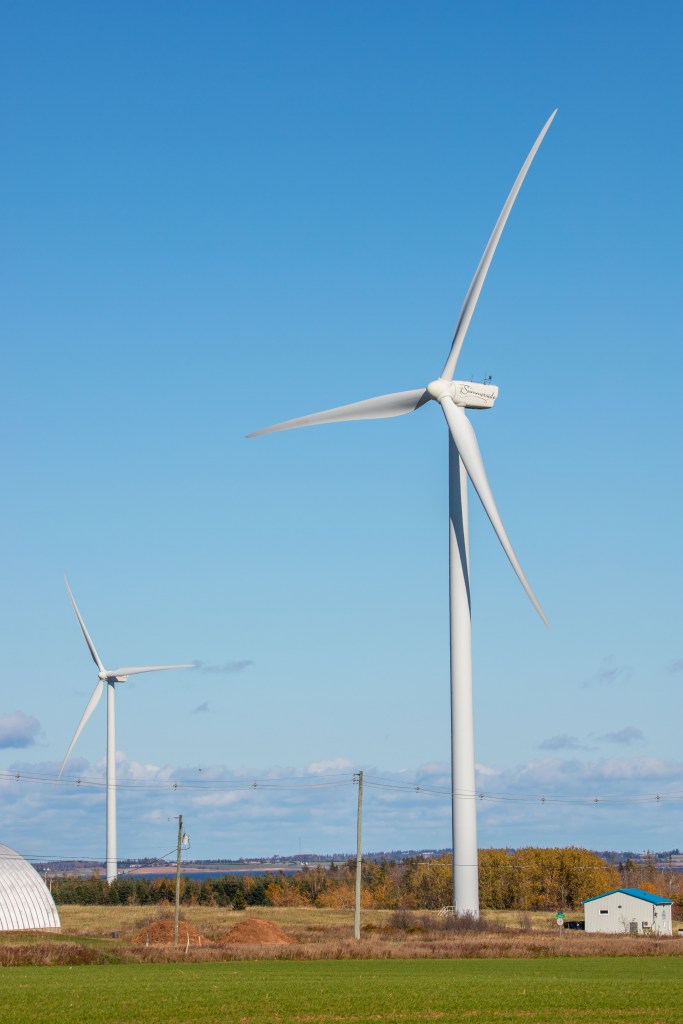
On the other extreme, large scale wind and solar projects, owned privately and even publicly, can present a related problem. PEI is famous for its wind farms, meeting many of the province’s electrical needs while using local resources and expertise, but their construction tends to benefit either the owner – in this case the PEI Energy Corporation – and the utility, Maritime Electric, with very few material benefits reaching consumers.
“There are models in Canada that are quite inspiring in terms of ensuring that we keep the benefits of resource development projects where they come from,” said Mercer.

He circles back to community ownership, the model he feels is best suited to maximize the benefits of renewable power while minimizing the drawbacks, on PEI as in Black Tickle. In cases such as Summerside, PEI, which owns its own electrical utility and wind farm, the technology is familiar, the resource is endogenous, and benefits quickly reach the people living among the turbines. He also points to Community Feed-In Tariff (COMFIT) programs in Nova Scotia, which required not only that proposed renewable energy projects be half community owned, but also relatively small, in line with community needs. This program has since been discontinued, Mercer laments, but had tremendous success while it lasted, establishing community owned windfarms and residential battery storage infrastructure.
“It’s really interesting to be on PEI, coming from Newfoundland and Labrador to a province which has seemingly embraced decarbonization and the pursuit of a net zero economy,” said Mercer. “I come from a long line of sailors, and they’ll tell you that having that net zero target, that “lighthouse,” is extremely important. Without it, it’s easy to get lost, but if you don’t have a properly designed ship, if you don’t have sailors trained for disasters, if you don’t chart your course before you leave, the lighthouse doesn’t mean much. It’s quite exciting to be here, in a new province to see this beautiful lighthouse on the horizon – net zero by 2040. What I’m trying to understand at the outset of my academic career is, how well trained are the sailors, and how well have we charted our course.”
Zack Metcalfe is a freelance journalist, columnist and author based in the Salmon Arm, BC.

 The Wandering Rook
Leave a comment