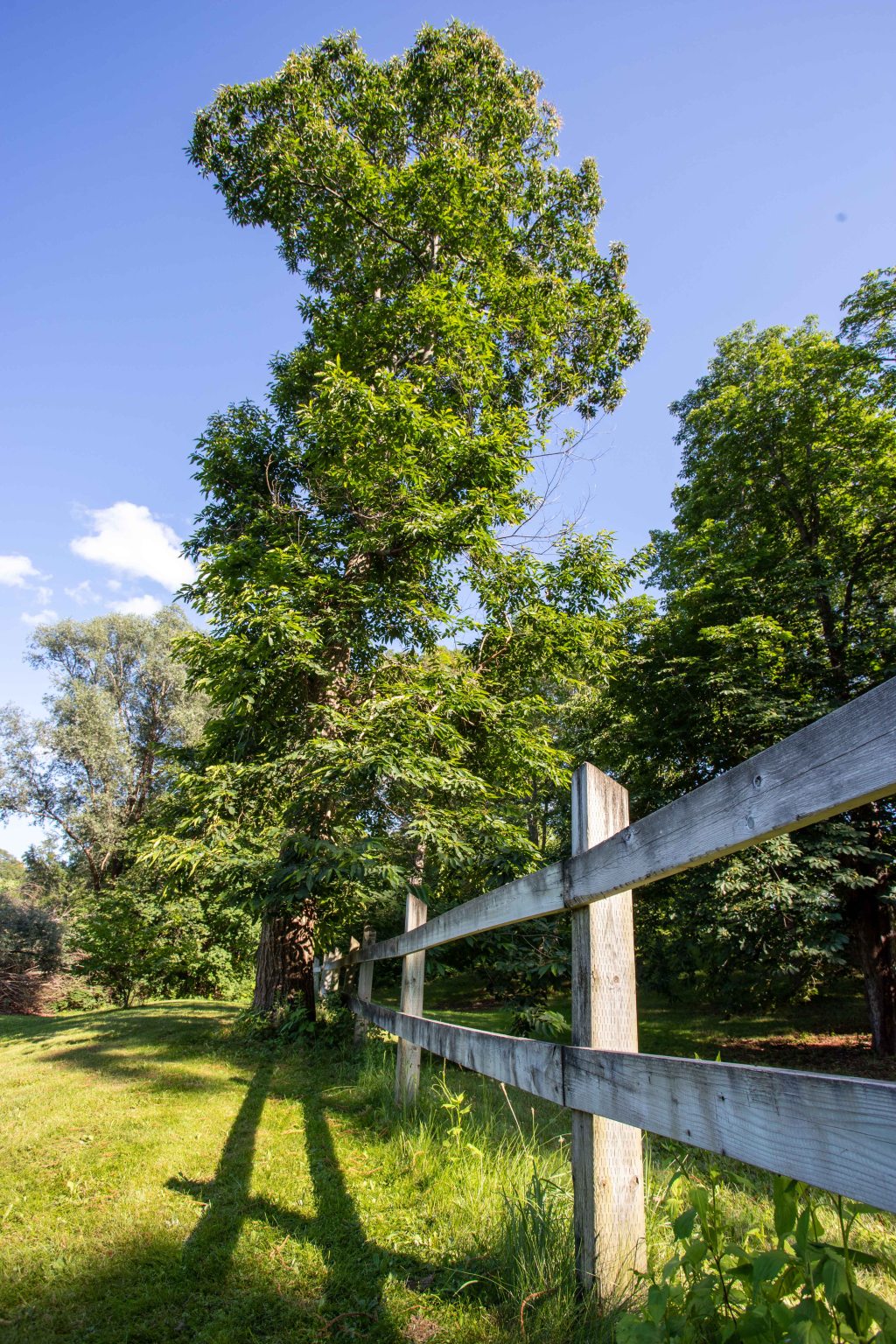
We can’t seem to let go of the American chestnut. Of all the trees to have disappeared since the Columbian Exchange, this one has maintained its grip on the human psyche, even now, a century after its reign. And yes, reign is the appropriate term.
As recently as 1900, American chestnuts accounted for a full quarter of all trees from Mississippi to Maine, dominating the canopies of eastern North America and pressing deep into southern Ontario. They were famous, in their time, for growing head and shoulders above their competition to establish a near monopoly over the sun, their greyish trunks wide and sturdy, unblemished by superfluous lower branches, and as straight as beams of light. They generated nuts in such staggering abundance that 275 species of animal were partially or wholly dependent on their seasonal bounties. The lumber these trees yielded ranked among the most rot resistant in nature, purportedly as strong as oak, yet much easier to work with. Their nickname – King of the Forest – was well earned.
The American chestnut was destroyed by a mail-order tree nursery in New Jersey, which, in 1876, imported and sold a dozen Japanese chestnuts, a distant cousin of our wild Americans. These Japanese chestnuts were nowhere near as tall, as hardy, as formidable as their native counterparts, but they had one important advantage – they’d evolved alongside Cryphonectria parasitica, a ferocious fungus native to east Asia against which Japanese chestnuts had developed a hard-won resistance. The trees imported to New Jersey carried this fungus as a matter of course, and from there, Cryphonectria parasitica leapt onto the unprepared American chestnut, manifesting one of the most lethal plagues in arboreal history – Chestnut Blight.

This invasive fungus burned across North America until about 1950, leaving in its wake the wreckage of cultures, industries and ecosystems once dependent on the American chestnut, 4 billion of whom had fallen to the blight. Familiar populations of mammal and bird collapsed for lack of food, as did other, smaller creatures not so easily appreciated, like the Chestnut weevil, Chestnut moth and Chestnut sawfly, several of whom stumbled into extinction.
And the American chestnut was predicted to follow, its surviving members too sick or isolated to make meaningful contributions to the recovery of the species. But since its collapse, a small army of swashbuckling conservationists has diligently picked up the pieces, breeding and planting and studying this tree in states and provinces across two nations, trying to find hope, and now, decades later, it appears they’ve succeeded.
The Maritime Chestnut
In 1905, a Nova Scotian named Clyde Dimock returned from seasonal work in the United States with an American chestnut 1-2 years old, which he planted on a backroad in Ashdale, Hants County, hoping it would grow into one of the regal giants he’d come to admire south of the border. And grow it did. Standing in the open with little competition for sunlight, it forsook the characteristic straightness of its species and grew haphazardly, like a Sugar maple in an open field, or an upturned squid, tentacles flailing. To support its wayward branches it developed a trunk of spectacular girth, standing now like a stout giant. The tree was struck by lightning in the 1950s, its leading stem obliterated, but the tree as a whole remained unfazed, surviving to this day, gnarled and Tolkienesque.

We call it the Ashdale Tree, the largest single American chestnut in Canada and perhaps in North America. It’s not the tallest – that honour belongs to a 115-footer in southern Maine – but in terms of sheer volume, Ashdale has no equal. Unlike its counterparts across the historic range of the species, this tree matured in the complete absence of the blight. Chestnuts never established themselves in Nova Scotia prior to human intervention, held back by glaciers, climate, and the width of the Bay of Fundy, so blight had no path by which to reach the Ashdale Tree. The Maritimes, therefore, became an impromptu refugia, sheltering American chestnuts from the blight just outside their native range.
There is a long and proud tradition of people migrating chestnuts into the Maritimes, before and after 1905. Sometime between 1815 and 1830, Nova Scotia’s attorney general Richard John Uniacke planted a pair on his country estate in Hants County where they grow to this day. Before him, the United Empire Loyalists – British citizens fleeing to Canada during the American Revolution of the late 1700s – brought an uncounted sum of American chestnuts into the Maritimes and Quebec. This resulted in a huge specimen which grew in Bridgewater, Nova Scotia, for several hundred years until it was cut down in the 1970s.
Perhaps the most notorious importation of all came in the 1980s from the now defunct Bowater Mersey Paper Company. That decade, for the sake of public relations, they purchased 300 seedlings from Cascade Forestry in Iowa and distributed them across Nova Scotia. But American chestnuts are remarkably picky growers. Soils must be acidic, fluffy and moist, temperatures must be consistent and predictable, and even then, survival depends very much on the individual trees. Many of those planted by Bowater died or were simply forgotten.
Since 1965, when naturalist C.R.K. Allen “discovered” the Ashdale Tree in Hants County, it has occurred to conservationists that the American chestnut might be preserved in Atlantic Canada, finding here a new home away from the blight, but neither the provincial government of Nova Scotia nor the Canadian federal government has ever involved itself in the effort. So, all work to date has been carried out by volunteers, pulling the American chestnut into the uncoordinated embrace of backyard conservation.
It probably began with George Swain, a horticulturist with the Kentville Research Station, who, entirely of his own volition, began trucking pollen between the Bridgewater and Ashdale trees, overcoming their 100-kilometre divide so they might reproduce. It took him years, but eventually the Ashdale Tree bore 20 viable nuts, yielding in turn 15 healthy seedlings. Records of their distribution are fuzzy. Seven seedlings, for instance, have never been tracked down, but of the remaining eight, two were apparently planted in an unknown location in Lower Canard, another four at the Kentville Research Station, and two more went to the Halifax Public Gardens in 1967, where they can still be found.

Another devotee of Maritime chestnuts was Leslie Corkum, a WWII veteran, forest ranger, forest technician, woodlot owner and accomplished firefight who, until his passing in April of 2020, dedicated much of his Falmouth estate to specimens collected from across Nova Scotia and imported from blight-free seed orchards in the United States, Ontario and elsewhere in the Maritimes. For years he followed up rumours of rogue chestnuts in the wilds of Nova Scotia and spent many a fall day combing their understories for viable nuts, to add to his collection or to plant in the company of isolated trees. He was also a diligent keeper of notes, tracking down and preserving many of the facts which compose this article.
“It’s a bad one to fall in love with,” he used to say of the American chestnut.
Today, the most active advocate for Maritime chestnuts is Jocelyn Clarke. On her property in Mount Steward, Prince Edward Island, she takes a total war approach to sheltering the species, her yard dominated by strong specimens collected from across the continent and her home permeated with nuts and seedlings in various stages of development, overwintering in freezers or else sprouting in old milk jugs and margarin containers on her porch. She has but one goal – hardiness.
A tree’s hardiness, specifically its ability to survive Canadian and Maritime winters, appears correlated with its ability to fight off Chestnut Blight, she said, improving its chances of maturing and reproducing before the illness rots its trunk. So she grows them, collecting and propagating those trees proven hardiest in Maritime climates for the sake of the species and for her own pleasure. She’s had good luck with chestnuts from the coastal regions of Massachusetts, the mountains of New York, a specific lake in Pennsylvania, some regions of northern Maine and southern Ontario, and, of course, with Nova Scotia, especially the Ashdale Tree, which has, to date, contributed heavily to breeding programs across North America.
“The Ashdale tree is a very good doer,” as Jocelyn put it.
She also maintains a catalogue of all American chestnuts known in the Maritimes. By Jocelyn’s count there are now thousands, but the exact figure is unknown. Not everyone with chestnuts is keen to share.
“There’s more than we think,” she said.
A Question of Genes
The Canadian Chestnut Council (CCC) was founded in 1988 to preserve the American chestnuts of southern Ontario, their volunteer staff and scientific advisors drawing heavily from Guelph University.
They’ve identified a little over 2,000 surviving American chestnuts in the province, and they keep a careful eye on each. From these trees they recover pollen and grafts, to establish their own nurseries, conduct research, contribute to breeding programs in the United States, or to send east, so people like Jocelyn Clarke can preserve their genes beyond the reach of the blight. They’ve also planted American chestnut seedlings around old and isolated individuals in the wild, so as to foster reproduction. And they track the blight, which occasionally tears across Ontario.
“The trees are dying faster than they can recruit in the wild,” said CCC chair Ron Casier. “Without us assisting, the American chestnut would disappear from Canada probably within 150 years.”

And it’s not just the blight. Casier describes mature trees destroyed by development or else cut down on private property by people unconcerned or unaware. Other chestnuts are just unlucky, like one fine specimen which succumbed to erosion, falling over a cliff into Lake Erie. A survey conducted by the CCC every ten years shows that between 2004 and 2014, a full 16 per cent of Ontario’s remaining American chestnuts fell to one misfortune or another. Over that same period, only seven new individuals took root in the wild. The American chestnuts of southern Ontario are fighting for survival, and they’re losing.
So, in the year 2000, the Canadian Chestnut Council undertook their most ambition project to date. Taking the healthiest 26 chestnuts known in Ontario, they cross-pollenated each with Chinese, Japanese and European chestnuts at the Connecticut Agricultural Experiment Station, so as to produce seedlings with the characteristics of native American chestnuts as well as the blight resistant of their foreign counterparts. Crossbreeding like this is not uncommon in North America. Many supposedly “pure” American chestnuts growing in the wild or purchased from tree nurseries are, in fact, hybrids, leading to a great deal of confusion in efforts to preserve the pure, native species.
In order to solve the problem of purity, the Canadian Chestnut Council began putting their hybrids through a rigorous “back-breeding” program, in which they were bred again and again with pure American chestnuts until their genetic profiles were between 98-99 per cent American, while still retaining the 1-2 per cent of their Chinese, Japanese and European heritage which confers resistance to the blight.
Once “purified,” their first generation of back-bred hybrids (referred to simply as “F1”) were planted in 2001, in research plots on Onondaga Farms in St George, Riverbend Farms in Calton, and on an acre of land which Casier donated to the effort, at his home in St Thomas, Ontario. There were 767 back-bred hybrids in all, but they were not alone. Following the principles of good science, the CCC also crossed the original 26 pure American chestnuts with each other, producing 643 pure seedlings which would serve as a “control group,” against which researchers could measure the blight resistance of their back-bred hybrids.

Dragan Galic, a researcher with Guelph University and tree technician with the Canadian Chestnut Council, has managed this blight resistance breeding program since its inception, dutifully infecting both groups of chestnuts with heavy doses of blight, then breeding together those which showed the greatest resistance in order to produce the next generation. The hybrid trees in F1, as predicted, proved themselves partially resistant to Chestnut Blight, a resistance which was intensified in their next generation, F2. But, to the amazement of Galic and the chestnut conservation community of North America, their control group, bred only from 26 pure American chestnuts, showed all the same blight resistance.
Galic and his colleagues with the CCC concluded that the 26 pure American chestnuts with which they established their control group must possess a natural resistance to the blight all their own, and when their resistance was concentrated by the breeding program into generations F1 and F2, it grew more and more potent.
“They’ve got something,” said Galic. “There’s no doubt in my mind.”
The mechanisms of resistance thus far identified come in three general categories, he said. There is the integrity of a tree’s bark, which prevents blight from infecting it in the first place; the ability of the tree to callus, isolating the infection into a canker so it cannot spread; and, finally, phytoalexins, a class of antimicrobial compounds which trees produce to fight infection, and which, apparently, these pure American seedlings are mobilizing in just the right proportions to combat Chestnut Blight.
The first two of these resistance mechanisms have been observed in both the F1 and F2 generations of pure American chestnut, while the third mechanism, the phytoalexins, is so far only inferred. Some of Galic’s pure American chestnuts have lived with lethal doses of Chestnut Blight for 20 years now, doses which would kill a wild tree significantly faster. Enchanted by the notion of breeding purely American, purely Ontarian, blight resistant chestnuts without the need for hybridization, the Canadian Chestnut Council has converted their control group into a full-fledged breeding program of its own. The back-bred hybrid group has not been abandoned, but they are no longer the CCC’s primary focus.

This program’s third generation, F3, went in the ground in 2020, produced from the healthiest and hardiest F2s. Casier hopes their F3s possess enough resistance to live with Chestnut Blight for as many as 150 years. Since chestnuts reach sexual maturity after only 15 years, and produce good lumber after only 50, this would allow the species to successfully survive and reproduce without human intervention, and contribute to forestry.
“We’re looking for a cultural restoration, an ecological restoration and an economic restoration,” said Casier.
Once the strongest individuals of F3 have been identified, the Canadian Chestnut Council intends to produce yet another generation, F4, and begin planting them in the wild, throughout Ontario, Quebec, and likely beyond.
“Our desire,” said Galic, “is to convert the [blight] into a common disease. It will be there, present, but the tree will continue with its life. It will be our third generation [of trees] that tell the story. We hope, down the road, there will be millions.”
The Curious Mix of the Maritimes
To say the Maritimes are entirely free of blight may be misleading. There was an isolated outbreak in Melvern Square, Nova Scotia, back in 2013, in which 60 trees planted together by the Bowater Mersey Paper Company were found to be infected, and were subsequently torched. Neither before nor since has blight been confirmed in the region.
So, the American chestnuts of the Maritimes are still relatively safe, and rank among the most genetically diverse populations in North America. There is stock from several distinct groups across the United States and from various regions in southern Ontario, some of which predates the blight and all of which has proven itself at least tolerant of Maritime winters. While recent work by Dr Brian Husband and PhD student Sophia Stoltz from the University of Guelph has shown several Maritime chestnuts to be hybrids of Chinese, Japanese or European descent, it also demonstrated that the region’s keystone trees, such as Ashdale, Bridgewater, Uniacke and at least several of those planted by Bowater, are pure Americans.

What role these trees should play in the recovery of the species depends very much on whom you ask. Some enthusiasts suggest these trees be propagated throughout the Maritimes, so as to fill the ecological niche left vacant by the American beech tree (also a nut tree, also devastated by invasive species). Others think such extensive propagation would open up the Maritimes to an outbreak of Chestnut Blight, and ultimately destroy what’s been preserved here. Some view Maritime chestnuts only as a curiosity, their value to breeding programs limited by the simple fact that we don’t know where most of them came from, their genetic backgrounds still largely mysterious.
Ron Casier takes a slightly different view, reasoning that more genetic diversity will ultimately result in a more resilient population. As the unique survival pressures imposed by the Maritimes favours stronger chestnuts and kills weaker ones, our region has the potential to generate some uniquely hardy trees.
“We’re not testing [for blight resistance] in the Maritimes,” said Casier, “but for all we know, you could be growing a resistant tree right now.”
Dragan Galic is of much the same mind. When his breeding program runs its course, he hopes to millions of trees from only 26 parents, which makes inbreeding an ever-present danger. The solution will be to plant his F4 generation in the presence of surviving, wild American chestnuts with as diverse a genetic palette as possible. When the time comes, he intends to deliver his F4s east, so as to tap the region’s genetic reserves.
“The only way [to save the species] is to cross the best with the best,” he said, “to accumulate as many of those genes as possible.”
Ultimately, the fate of the American chestnuts of the Maritimes will belong to Maritimers themselves, the people who brought them here, who bred them here, who own the land on which they grow and who are willing to plant and protect and propagate them now, for the sake of the species, of forestry, or just to grow their own chestnuts. Wherever these Maritime trees may have come from, it seems clear they are now home.
Zack Metcalfe is a freelance journalist, columnist and author based in Salmon Arm, BC.



 The Wandering Rook
Leave a comment