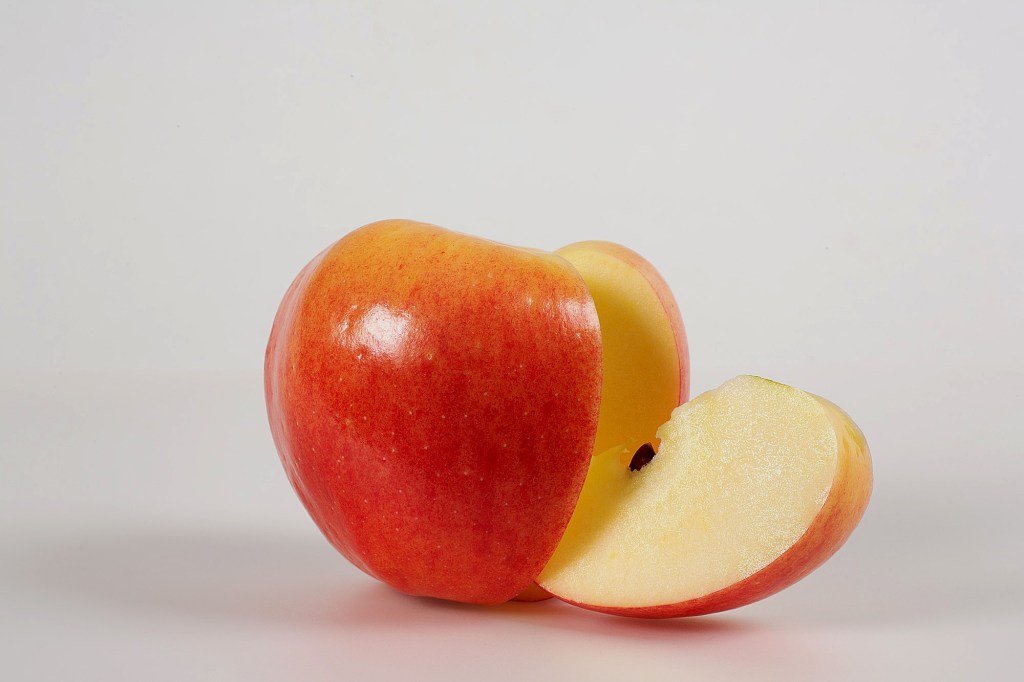
The commercial release of the Honeycrisp apple in 1997 marked the end of an era. Up until that point, the development of new apple varieties followed a largely open source model. When something new and exciting rose from the chaos of apple reproduction, anyone could buy it, plant it, grow it and sell it. MacIntosh, an apple variety developed in Canada in 1811, belongs to no one, and therefore to everyone, provided you can afford a sapling at your local nursery.
Since 1990, Canadian apple breeders have been able to assert ownership over a newly developed variety by invoking “plant breeders’ rights,” which, in many countries, function just like a patent. For a specified number of years – in Canada it’s 25 – the breeder maintains the right to their variety, so that anyone keen to buy it from a local nursery would also pay a modest royalty back to the breeder. This allowed breeders to recuperate their costs, even earn a profit.
Then along came Honeycrisp, initially developed at the University of Minnesota in the 1960s by crossing Macoun and Honeygold. Its crispness took breeders by surprise, one of them, David Bedford, describing his first bite to NPR in 2014. For a long while he just stood there, chewing, unable to decide if its utterly unique texture was a good thing or bad. His mind had already been blown. His tongue took a few minutes to catch up.
The variety was patented (the United States uses “plant patents” rather than “breeders’ rights”) in 1988 ahead of commercial release, so that when orchards began adding this “explosively crisp” apple to their roster, they paid a small royalty, per tree, to the University of Minnesota. This patent has since run out, ushering Honeycrisp entirely into the public domain.
Not only did Honeycrisp do exceptionally well, dominating orchards in New England and the Maritimes, but customers were willing to pay more for Honeycrisp than for any of its predecessors, which changed the game for the people growing it. In the words of PEI orchardist Nancy MacKay, “it’s the revenue from Honeycrisp that keeps apple farmers alive.” It proved there was a larger market for new varieties than previously appreciated, a potentially profitable one.
Before its patent expired, the University of Minnesota earned over $10 million in royalties from Honeycrisp, set against 31 years of development and several million dollars of investment. It would become the last major apple released as an open variety. A new approach was gaining steam, one which returned more money to breeders, maintained better prices for orchardists, and pushed new varieties in a competitive market. All that was missing were apples capable of competing with Honeycrisp, so breeders got to work, trying to shove lightning back into the bottle.
The Club
Cripps Pink is an apple variety developed by Australian plant breeder John Cripps in the 1970s, but unlike Honeycrisp, it was not released as an open variety for anyone to grow. Instead, it became the very first “club variety.”
When a breeder restricts the number of orchards allowed to grow their apple, it becomes a club variety, available only to orchards in partnership with the breeder – in the “club.” The reasons for this exclusivity are myriad. First, maintaining control over who can grow their variety gives breeders control over how it is grown, so that quality can be kept consistent. The club model also controls the amount of product reaching the market at any one time, keeping prices more stable, and, in general, higher than for open varieties. The final piece is marketing.
Under the club model, partnering orchardists generally pay a levy to the breeder for every apple sold. Where this money goes – back into breeding programs, for instance – depends on the breeder, but in many cases, this money is put toward marketing. It would make no sense for any one grower to spend money advertising the Honeycrisp apple, because anyone can grow Honeycrisp, not just the orchard taking out the ad. In the case of club varieties, however, returns from marketing are restricted to the club. Many club apples have their own advertising campaigns, their own logos and stylized packaging, their own websites, their own fan mail.
Some club apples are even sold under a trademarked name. The Cripps Pink apple, for instance, is sold as the Pink Lady, a trademark which comes with very specific standards for taste and appearance. If, for instance, a partnering orchard produces an apple whose skin is not sufficiently red, it will be denied the Pink Lady trademark, sold merely as Cripps Pink or turned into cyder. Even though the variety, Cripps Pink, will eventually enter the public domain, the trademarked Pink Lady is forever. Its specific growers, standards, appearance and name will remain the property of the breeder, against which open sourced Cripps Pink will have to compete without a marketing apparatus of its own, even though it’s exactly the same apple.
Ambrosia is another early club variety, developed in British Columbia and grown, for a time, exclusively by club orchards, but its name was never trademarked, so when breeders’ rights expired in Canada, it became an open variety is every possible sense. Anyone in Canada can grow it and sell it, and they can call it Ambrosia while doing so.
Criticisms of the club variety model centre on its exclusivity. Breeders outside the “club” will not have access to the newest and sexiest varieties, and even when breeders’ rights expire, independent orchards will be competing against established trademarks.
“It could be a positive or negative depending on where you are in the industry,” said Emily Lutz, executive director of the Nova Scotia Fruit Growers’ Association. “If it’s creating a more profitable model for commercial apple farms, that’s a good thing.”
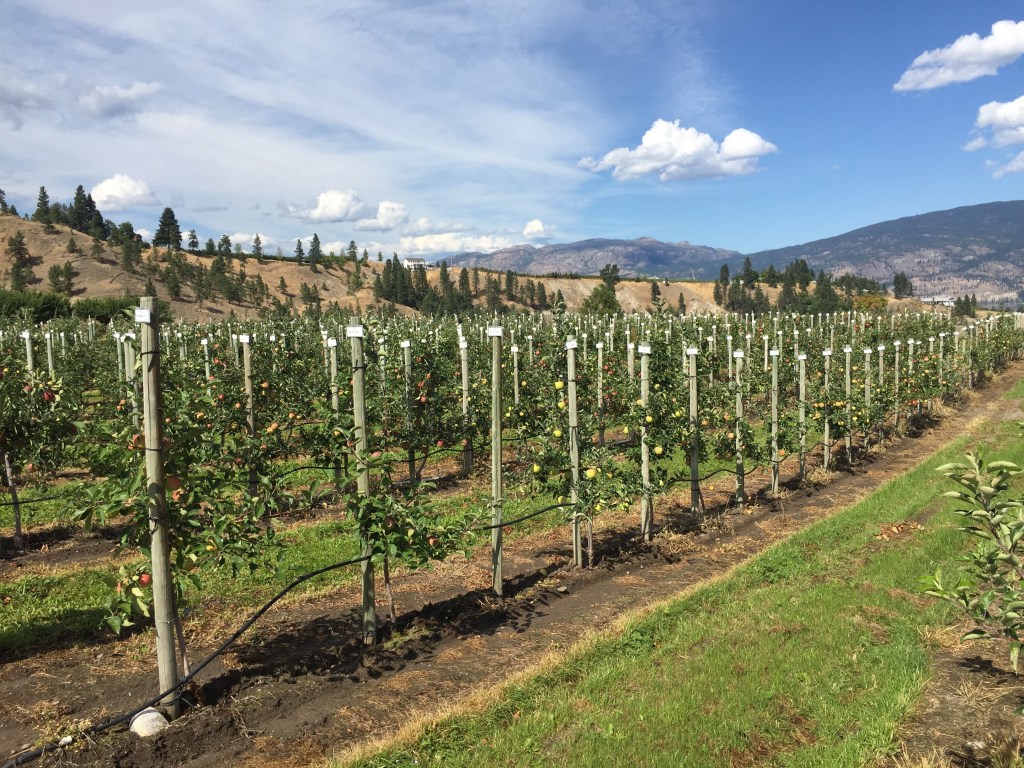
The Summerland Research and Development Centre in British Columbia, an institute experimenting with 30,000 different apple varieties at any one time on behalf of Agriculture and Agri-Food Canada, is adopting the club model for some its most recent varieties. One is called Snowflake (TM) for the white lenticels peppering its red skin, and is purported to be crisp, juicy, and equal parts tart and sweet. It will be grown by Algoma Orchards in Ontario.
Summerland will also be experimenting with a tweaked club model, what they’re calling the “Canadian Club,” in which partnerships are proposed in every province, so that one of their newest varieties – so new it hasn’t yet been named – can be grown in as many Canadian orchards as possible. The club model would be maintained, but the exclusivity would be Canadian. The new variety in question has the appearance of a nectarine, and a flavour to match. It, and the Snowflake (TM), should be expected in the coming years.
The Next Honeycrisp
Orchardists in both Prince Edward Island and Nova Scotia claim to grow the best Honeycrisps in the world, and while their claims are mutually exclusive, they are not without merit. A combination of temperate climates (mediated by the Gulf of St Lawrence and Bay of Fundy respectively) and autumns with warm days and cold nights, encourage the development of heavy reds in the skin of Honeycrisps, a prized trait, no matter the market.
In Nova Scotia, Honeycrisp is the most grown apple by volume, fetching a consistently higher price than traditional varieties. This is interesting, said David Parrish, president and CEO of Scotian Gold Cooperative Limited. If you were to poll the cooperative’s employees, “apple snobs,” as Parrish describes them, Honeycrisp might rank third on their list of favourites, at best. To their refined palates, the flavour of Honeycrisp is easily beaten by Ambrosia, which Parrish puts in second place. In first place, by a wide and growing margin, is SweeTango.
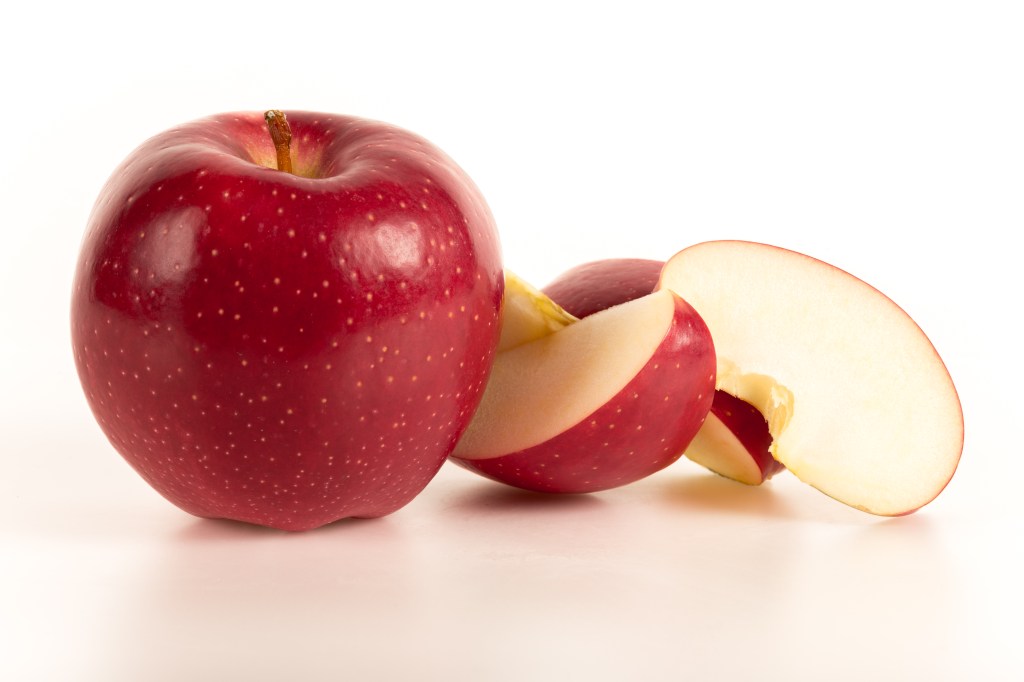
Following the outrageous success of Honeycrisp, the University of Minnesota began the arduous work of duplicating their miracle, eventually crossing the acclaimed Honeycrisp with the variety Minnewashta (sold under the trademark Zestar!). The resulting tree was called Minneiska, its apples as crisp as Honeycrisp, but somehow more flavourful. The trademark given to this novel club variety was SweeTango, Honeycrisp’s literal and spiritual successor.
The exclusive rights to grow Minneiska apples, and to market the prettiest specimens as SweeTango, went to the Minnesota based grower’s cooperative Next Big Thing. Scotian Gold is a member of Next Big Thing (a cooperative within a cooperative), and so enjoys access to a specified number of SweeTango trees. Parrish couldn’t say how many they presently have in the ground, but he did say the number is growing year after year.
“We’ve been working with SweeTango 15 years,” said Parrish. “That’s something that doesn’t just happen overnight.”
SweeTango has its own website and supporting marketing campaign, but just because an apple is a club variety doesn’t mean it will succeed. Parrish said that SweeTango is popular, but that many of their 15 years growing it were spent “testing the market.” Planting a fruit tree is a long term commitment, said Parrish, and not all orchardists will switch for an unproven variety. By way of example, Scotian Gold works with another club variety called Sonya, this one from New Zealand. It’s performed poorly, and its production in Nova Scotia is being cut back. Even SweeTango has a long way to go before dethroning Honeycrisp.
Competition is still strong from open varieties, and in time (2026 in the United States and 2033 in Canada) SweeTango will even need compete with itself, when the patent and breeders’ rights of the University of Minnesota expire, and Minneiska apples can be grown and sold my orchardists outside Next Big Thing. These Minneiska apples won’t have the trademarked SweeTango name, the marketing budget or the quality assurance, but it remains to be seen if customers will care.
It’s too early to say if club varieties will come to dominate the market, said Parrish. He safely predicts, however, that as more and more varieties arrive in force, they won’t just be competing for customers. They’ll be competing for space.
“The variety market has almost become saturated at this point,” said Parrish. “At one time you could go to a retailer and they’d be all excited that you came with a new variety. Now, if you go to a retailer with a new variety, they’ll say, well, it’d better be good. It’d better be better than what I have on the shelf, because there’s a variety coming off the shelf in order for me to find room for this.”
Whether this jostling of varieties will push out open, traditional varieties is another question for which no one has an answer. So far, said Kelly Ciceran, general manager of the Ontario Apple Growers, club varieties have been very transient, occupying grocery store shelves for only a few years before declining in favour of something more traditional. In spite of the mounting popularity of club apple varieties like SweeTango, open varieties apparently still have some fight in them.
“For the foreseeable future, I think the standard varieties will continue,” said Ciceran. “Certainly Gala, Honeycrisp and Ambrosia are very popular.”
Zack Metcalfe is a freelance journalist, columnist and author based in Salmon Arm, BC. This article was originally published with Rural Delivery Magazine.


 The Wandering Rook
Leave a comment