
Anthony Taylor, associate professor with the University of New Brunswick, has dedicated a career to the relationship between forestry and climate change. Born and raised in Nova Scotia’s logging sector, much of his undergraduate education and indeed his master’s thesis concerned carbon sequestration in Canadian forests. Now, an academic himself, he gets into the weeds of climate friendly forestry.
In a 2023 paper, published with the journal Nature, he asked if forests with a greater diversity of trees were better at sequestering carbon than those with fewer. This is not a new idea – biodiversity manipulation studies, in which agricultural fields or grasslands are sown with a greater or lesser diversity of plants, have consistently shown that more species sequester more carbon in the soil, but this phenomena had never been confirmed in wild forests, where similar manipulation studies would take decades.
But Taylor and his co-authors found an acceptable substitute. For the past few decades, the Canadian federal government has maintained “permanent sample plots” in wild forests across the country, from which they’ve periodically collected data, including the diversity of trees present, and the quantities of carbon in the soil.
“We’re blessed in Canada to have this wide network of sample plots,” said Taylor. “They span the country’s various ecosystems, and they’ve all been repeatedly measured over time.”
Taylor’s study incorporated data from 406 of these sample plots, and after controlling for things like age and climate, he and his co-authors were able to clearly demonstrate that what was true of crops and grasses was also true for trees – the more species of trees present, the more carbon contained in the soil, and not just carbon, but also nitrogen.
“If you take everything as a whole,” said Taylor, “a forest’s functional diversity increased the soil’s accrual of carbon and nitrogen by 30-50 per cent.”
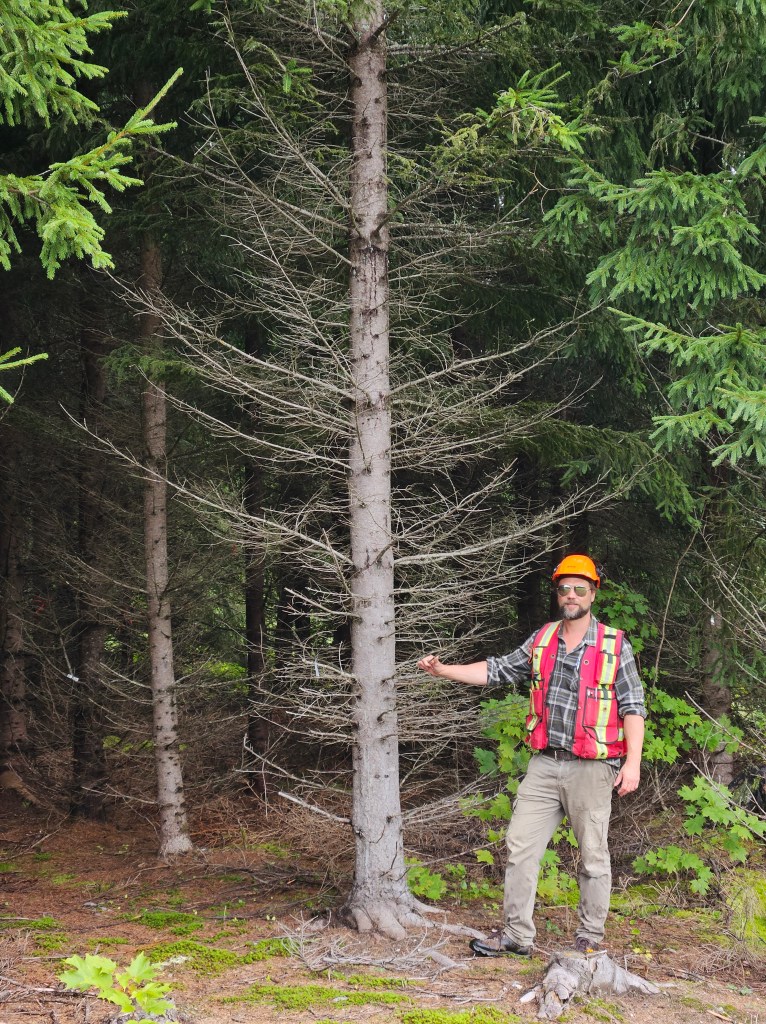
The key word here is “functional” diversity. Taylor and his co-authors discovered that the absolute number of tree species wasn’t enough to explain the wide range in carbon and nitrogen sequestration observed in their 406 plots. It also mattered if species occurred in roughly even numbers, and just how different those species were from one another.
A forest dominated by Black spruce with one or two White spruce, for example, won’t sequester as much carbon or nitrogen as one with Black and White spruce in roughly even proportion. And that same forest of Black and White spruce (closely related conifers) won’t sequester as much carbon or nitrogen as a forest with Black spruce and Red maple, one being a conifer and the other a broadleaf. The sequestering powers of a given forest depends on the number of species present, their relative distributions, and the diversity of their characteristics.
There are likely dozens of mechanisms linking tree diversity to carbon and nitrogen sequestration, said Taylor, but he and his co-authors identified a few in particular, each to do with tree behavior. Different species of tree employ different survival strategies, whether this means a preference for shade or full sunlight, acidic or basic soil, partnerships with some soil bacteria and fungi and not others, etc. The more strategies (species) that exist in a given stretch of forest, the more efficiently available resources can be used. This, so the theory goes, promotes more overall growth, and thus the accumulation of more plant debris (carbon) in the soil over time. More species of tree also means more strategies for collecting, recycling and retaining nitrogen, the most important macronutrient for plant growth, and in fact the primary limiting factor in the growth of many Canadian forests, such as the Boreal. More nitrogen means more growth still.
“If you have trees that are growing more – they’re growing bigger, they’re growing faster – then you have greater turnover of leaf litter and fine roots into the soil,” said Taylor. “That contributes carbon to the soil at a greater rate.”
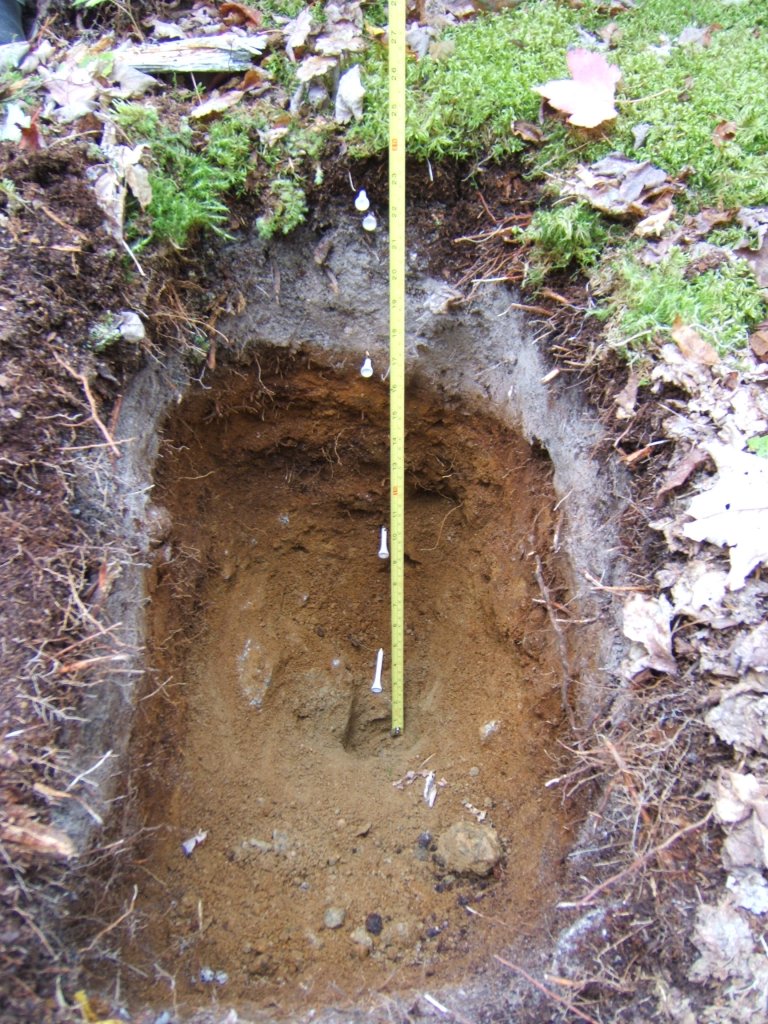
Canadian forests store between two and three time more carbon in their soils than they do in the tissues of living plants, and a full third of the carbon presently driving climate change in the atmosphere was emitted when forests and their soils decomposed following human disturbance. Forest soils, therefore, represent an enormous opportunity to mitigate climate change, said Taylor, and the finding of his paper suggest that harnessing the storage capacity of working forests means managing them for diversity.
“There are always going to be individuals in forestry who want to grow monocultures of one particular tree for particular reasons,” said Taylor, “and some forest is better than no forest, in my opinion, but where we can, I think we should start to protect and maintain a diversity of species in our forests, and especially here in the east, even enhancing the number of tree species in our forests.”
In practice, said Taylor, a powerful tool for climate friendly forest management could be professional tree marking, in which qualified individuals marked trees ahead of selection cuts not only to preserve the forest’s overall health (removing diseased individuals, etc.) but also an even distribution of as many tree species as possible. The effectiveness of professional tree markers in maintaining forest health and stand diversity is the subject of forthcoming studies in southern Nova Scotia.
Clearcutting tends to reduce a landscape’s overall tree diversity and thus its ability to sequester carbon, said Taylor, and while he believes there’s a time and place for this kind of intensive management, Taylor said selection harvesting should become the norm in forests managed for climate change. The need to maintain a forest’s functional diversity also brings treatments of glyphosate into question, he said, because their express purpose is to hinder the growth of broadleaf tree species.
“As a society, at least in our public forests, I think we should be promoting species diversity when and where we can, and part of it is for the reasons mentioned in this paper, like sequestering carbon and nitrogen in our soils, but there’s a slew of other reasons, too, like climate adaptation. The best advice I have for people is to maintain forest diversity. Maintain that diverse portfolio as the climate changes, just as any financial strategist would tell you to do when weathering an economic storm.”
Zack Metcalfe is a freelance journalist, columnist and author based in Salmon Arm, BC. This article was originally published in the Atlantic Forestry Review.


 The Wandering Rook
Leave a comment