
European Fallow deer have walked Sidney Island, BC, since at least the 1960s, ferried over – best we can tell – by people keen to hunt them. This is not an original story. Fallow deer have been world travellers since the Roman Empire, plucked from their native range in the Mediterranean and set down as far afield as the British Isles, South Africa, Argentina, New Zealand, Australia and Tasmania, almost always for the hunt.
They came to the Southern Gulf Islands – in the Georgia Strait between Vancouver Island and the mainland BC – as both livestock and game throughout the 20th century, but hunting declined, fences failed, and farmers walked away, leaving these invasive ungulates to spread. Today, they dominate the isles of Mayne, Galiano, James, and Sidney.
On each of these four islands, introduced Fallow deer promptly outcompeting native Black-Tailed deer, reducing them to a minority in their own habitat. Black-Tailed deer are solitary creatures, requiring a great deal of personal space. This puts a social barrier on their population growth, but Fallow deer have no such hangup. They form massive herds, cheek by jowl, which grow and grow until there’s nothing left to eat.
“When the population was at its highest,” said Bruce Ledingham, a resident of Sidney Island since the 1980s, “they ate everything. There wasn’t anything on the island that was green, that wasn’t nibbled right down to the ground, to the point that the animals were starving.”
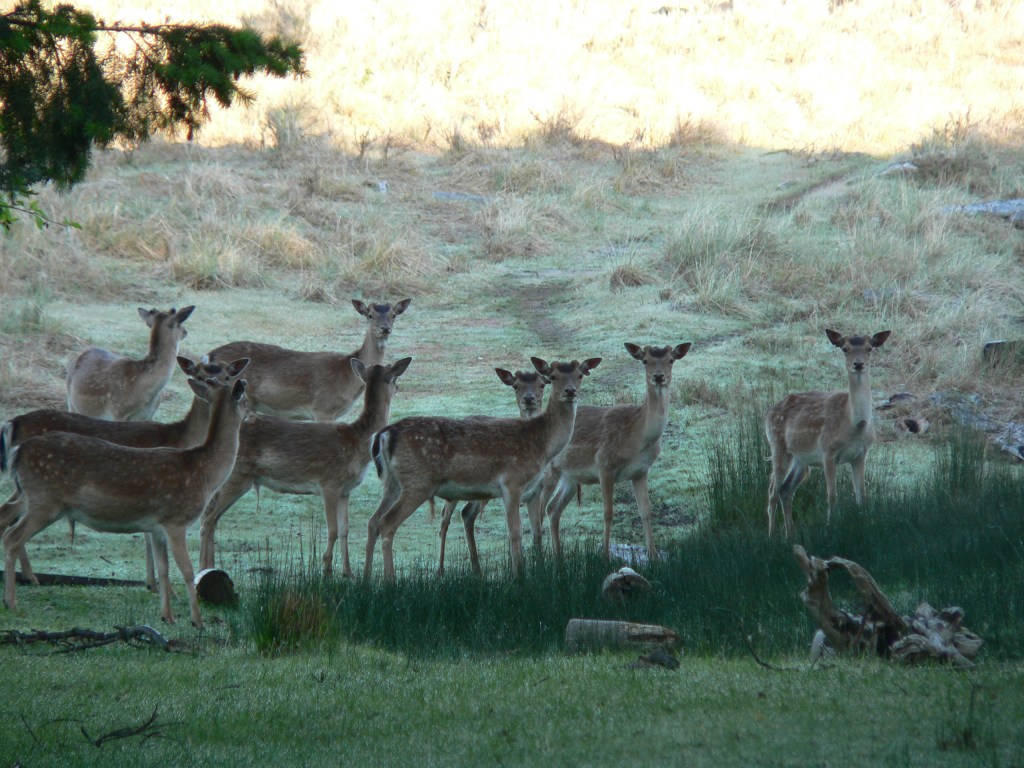
In the absence of predators like wolves and cougars – eradicated from the Southern Gulf Islands decades before – and with recreational hunts only able to take so much, these invasive deer became “hyperabundant,” and then desperate, eating even the least palatable plants, like the shrub Scotch broom, a fellow invasive species. They were emaciated, said Ledingham, with protruding ribs and sunken haunches. There was so little meat on their bones, he said, that hunted deer often couldn’t be eaten. Veterinary examinations showed they were consuming their own bone marrow.
The Southern Gulf Islands support a greater diversity of vascular plants – and a greater density of species-at-risk – than any other region in British Columbia. They are the heart of the so-called Coastal Douglas-Fir Biogeoclimatic Zone (CDF), accounting for 0.3 per cent of the province’s landmass, and because the CDF is so heavily developed, by Vancouver in the east, Victoria in the west, and innumerable farms and cottages across the islands themselves, precious little of those 0.3 per cent are still “wild,” still strongholds of species which cannot be found anywhere else in the province.
Garry Oak Meadows, an iconic ecosystem of the CDF, support a hundred separate species-at-risk by themselves, like White-Topped aster, Deltoid balsamroot, Great camas and Golden Indian paintbrush. What remains of the CDF was already suffering under Black-Tailed deer, overabundant in the absence of native predators, but European Fallow deer the coup de grâce.
“We have deer hyperabundance across the Southern Gulf Islands,” said Tara Martin, professor of applied conservation science with the University of British Columbia, “but it’s usually just Black-Tailed deer. They alone never achieve the same level of ecological annihilation as the combination of Black-Tailed deer and European Fallow deer.”
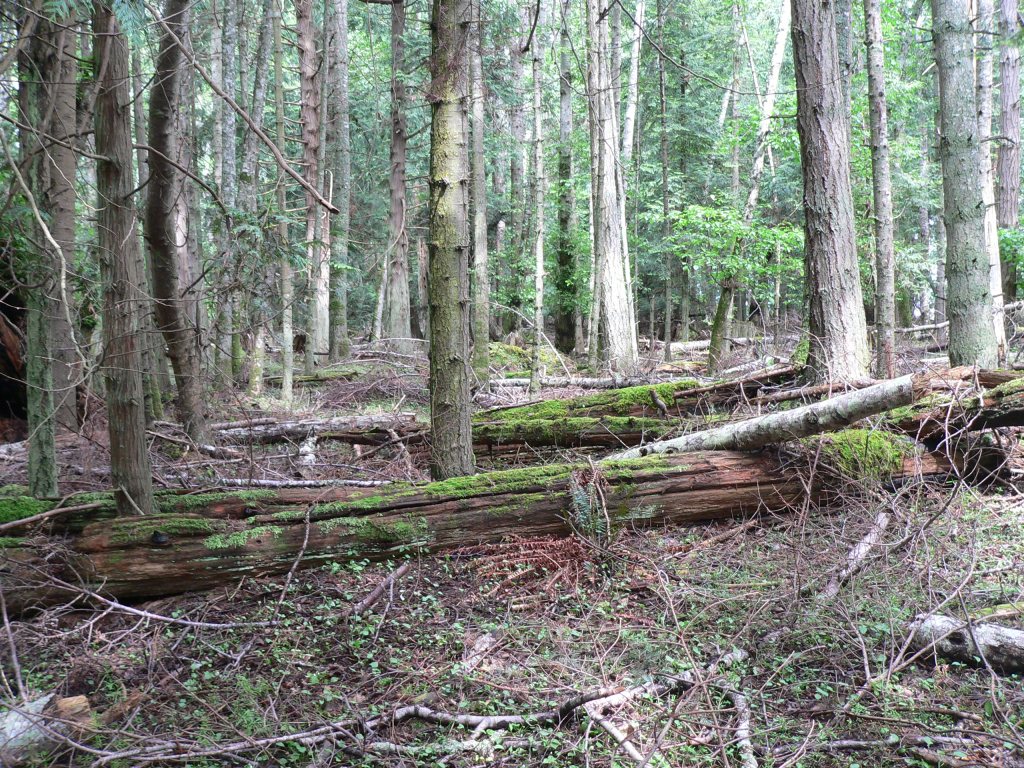
When Fallow deer exceeded 2,000 individuals on Sidney in the early 2000s, the island developed a “browse line,” extending from ground level to about shoulder height, where nothing at all could grow. Trees, said Martin, like Garry oak, Western redcedar and arbutus, became the “living dead,” unable to produce seedlings as quickly as deer ate them up. Several species of vascular plant, like Trailing blackberry, Thimbleberry and Saskatoon serviceberry more or less disappeared, and the effects weren’t restricted to vegetation. Martin found that, among the Southern Gulf Islands of British Columbia and the San Juan Islands of Washington State, more deer consistently meant fewer songbirds and pollinators, since there was little food or habitat for either. Bumblebee populations were in some cases halved.
“Of all the islands we sampled among the Southern Gulf and San Juan islands,” said Martin, “Sidney Island was in the worst condition.”
Efforts to control Fallow deer on Sidney Island go back decades, the keystone of which was a “deer capture facility,” operated by island residents. It entailed a slaughterhouse attached to a large outdoor paddock – about 40 acres – with four gates. The paddock was baited with alfalfa, and after a few days, volunteers closed its gates under cover of darkness. The next morning, any Fallow deer caught inside were separated, killed with a bolt gun, processed for meat and sold to restaurants in Vancouver and Whistler.
“I spent some time with the killing process as a volunteer,” said Bruce Ledingham. “It’s not something I’m proud of, but it had to be done.”
Since the 1980s, over 15,000 Fallow deer have been killed on Sidney Island, via hunting, hired sharpshooting, and the deer capture facility, keeping their population in the hundreds rather than thousands since about 2008.
“A huge number of deer have been removed from the island, and we are seeing ecological recovery,” said Martin. “It looks dramatically different than it did 15 years ago, which is exciting, but it hasn’t fully recovered.”
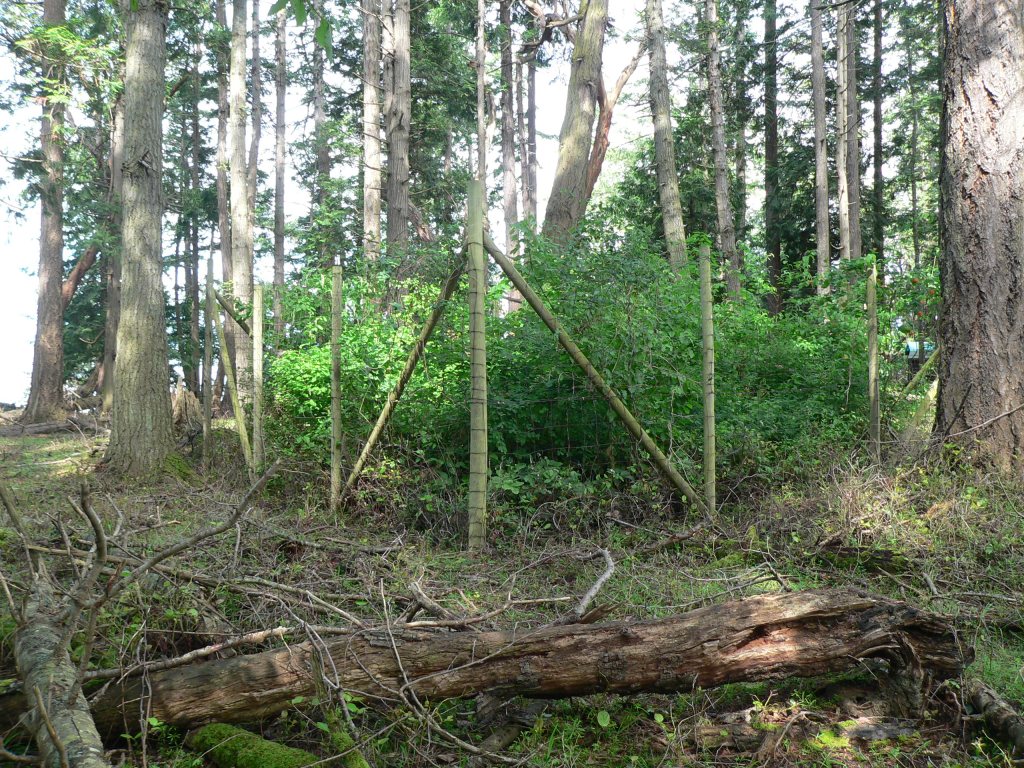
The bulk of this recovery has been among the island’s least palatable species, like Grand fir. Previously diverse forests are, in some cases, returning as monocultures of this single tree, while Garry oak and Western redcedar still can’t sneak their seedlings past hungry deer. Unpalatable invasive plants, like Scotch Broom, have also been gaining ground while more palatable native species, like Chocolate lily, Fawn lily and Samas, continue to disappear. The only exceptions are those protected by fenced exclosures, where palatable and unpalatable species alike have erupted in more or less natural proportions. Wherever deer are excluded, regrowth is diverse and vigorous.
A permanent solution to the deer problem has been batted around for decades, but in 2018, a steering committee including Parks Canada (which manages 30 per cent of Sidney), island residents (52 per cent of whom ultimately voted in favour), the W̱SÁNEĆ Leadership Council, the Tsawout and Pauquachin first nations, the Province of BC and the Islands Trust Conservancy settled on the total eradication of deer from Sidney Island.
The eradication is taking place in two phases, the first carried out in the fall of 2023. Professional marksmen hunted deer on foot and from helicopter, not only to kill deer (subsequently dressed for meat and hides by the project’s First Nation partners), but to get a sense of where the herds take shelter when pursued. 84 deer were taken in this phase, from an estimated population between 300-900 (probably closer to 300). The second phase of the eradication will take place over the winter of 2024-2025, during which the island will be subdivided and swept by professional marksmen until all deer have been killed, Fallow and Black-Tailed alike. It was considered impractical to distinguish between the two species in the field, and Black-Tailed deer – significantly better swimmers than Fallow deer – are expected to repopulate Sidney from neighbouring islands on their own, gaps of water too wide for Fallow deer.

“The next key action, already underway, is to remove some invasive plant species as well,” said Kate Humble, superintendent of the Gulf Islands National Park Reserve. The expectation, she said, is that by tearing out the English hawthorn and Scotch broom invading the various landscapes of Sidney, and replanting with native species either rare or locally extinct, they can give the island’s devastated vascular plant communities a kickstart.
“We’re really hopeful that, with supportive replanting, we will have really thorough recovery,” said Humble.
The Black-Tailed deer of the Southern Gulf Islands will always need to be managed, said Tara Martin. Options evaluated by herself and PhD student Sofie McComb include allowing wolves and cougars to recolonize the Southern Gulf Islands, and to cultivate a team of professional hunters among the local First Nations, but while both options are affordable and practical, they’ll take time, and will have more luck balancing the ecology of these islands if they need only contend with Black-Tailed deer, and not European Fallow deer. “These islands evolved to have some Black-Tailed deer, and they’re always going to have some Black-Tailed deer,” said Martin, “but they haven’t evolved to have Fallow deer. I think, morally, we have a responsibility to all the native species that are being whipped out.”

 The Wandering Rook
Leave a comment