
It was a little like chasing ghosts. Every trail was pulverized with fresh hoofprints, peppered with fresh dung and plastered with fresh mats of fur, as if a stampede had roared through only seconds before. I could even hear them at times, grunting methodically as they tore at grass somewhere within earshot, or moved in urgent masses from one pasture to the next. But I couldn’t see them, their steepled shoulders and dangling jaws somehow lost among the stumpy spruce of Elk Island National Park.
Here again, I thought, was the vanishing act of Plains bison, departing so suddenly the ground was still warm, the air still musky. It’s a trick they’ve pulled before – defining the Great Plains from Alberta to Mexico at the dawn of the 19th century, and by its dusk, ours was a continent of bones.
We have no idea how many there used to be. 25 million is an oft repeated estimate, but more visceral are stories of horsemen riding for days to circumnavigate a single herd, or of entire landscapes smothered beneath bison biomass. One encounter near Last Mountain Lake, Saskatchewan, was described by Isaac Cowie of the Hudson’s Bay Company in 1869.
“We fell in with buffalo innumerable,” he wrote. “They blackened the whole country, the compact moving masses covering it so that not a glimpse of green grass could be seen…The earth trembled day and night, as they moved in billow-like battalions over the undulations of the plain.”
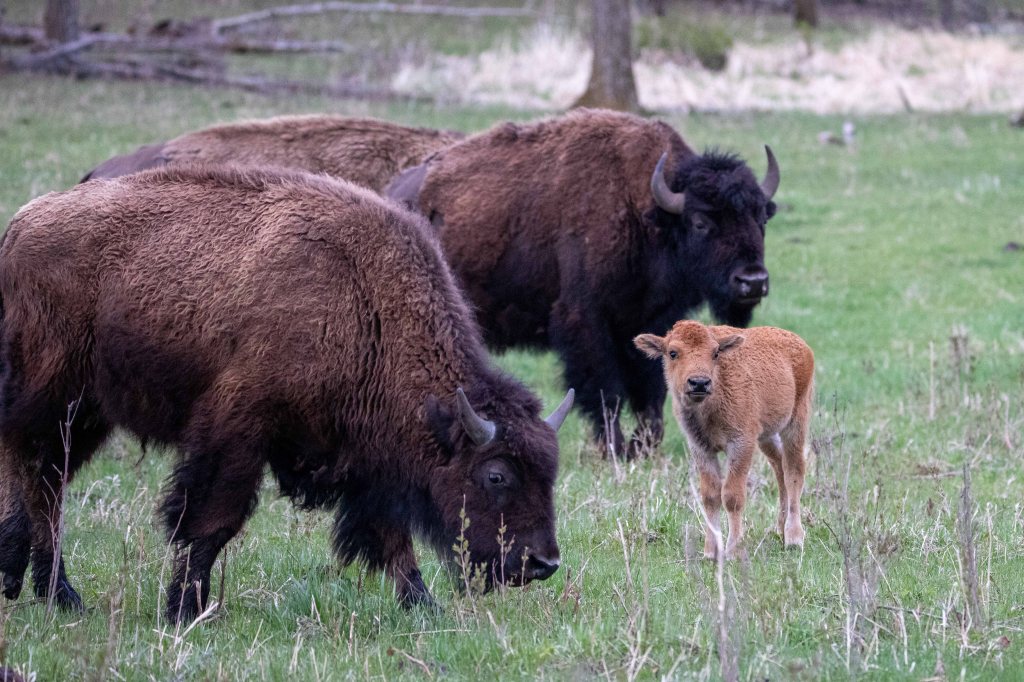
By 1881, this wild herd – in fact all wild herds – had been destroyed north of the 49th parallel, and those south of the line were reduced to a few pitiable flocks, totalling maybe a thousand individuals. An unregulated market hunt colliding headlong with a shifting climate, introduced disease, habitat loss and a culture of spectacular waste, all but obliterating Plains bison from the Earth.
Elk Island National Park, Alberta, is one of the precious few reasons they still exist. In the final days of the 19th century, a handful of entrepreneurs collected the last of the world’s wild bison onto ranches throughout the United States, the Pablo-Allard herd in the Flathead Valley of northwestern Montana being the most famous. It was built of local bison, and supplemented with specimens from Saskatchewan, Texas and Kansas. Today, 80 per cent of all bison are direct descendants of this heroic hodgepodge.
Around 1904, the Canadian government purchased Michel Pablo’s half of this herd, 800 animals earmarked for the newly christened Buffalo National Park near Wainwright, Alberta. But the park wasn’t quite ready for them, so these bison enjoyed a layover in Elk Island. Because they were popular, and because they were overlooked, a few dozen never left.
Buffalo National Park became an underfunded quagmire of disease, mismanagement and overpopulation, closed in 1939 when its remaining bison were euthanized. The lucky few left behind in Elk Island became Canada’s de facto “seed herd,” its members used to establish new herds in turn.
Elk Island is where Canada assumed responsibility for a species, and not just any species. This one was an ecosystem engineer, shaping prairies to the benefit of land and beast. This one was mobile, accustomed to absolute freedom in one of the largest continuous ecosystems on the planet. This one was prolific, its herds enjoying an average annual growth rate of 20 per cent. And somehow, they were to be kept healthy and wild in the modest spaces allotted to them, behind fences and cattle guards.
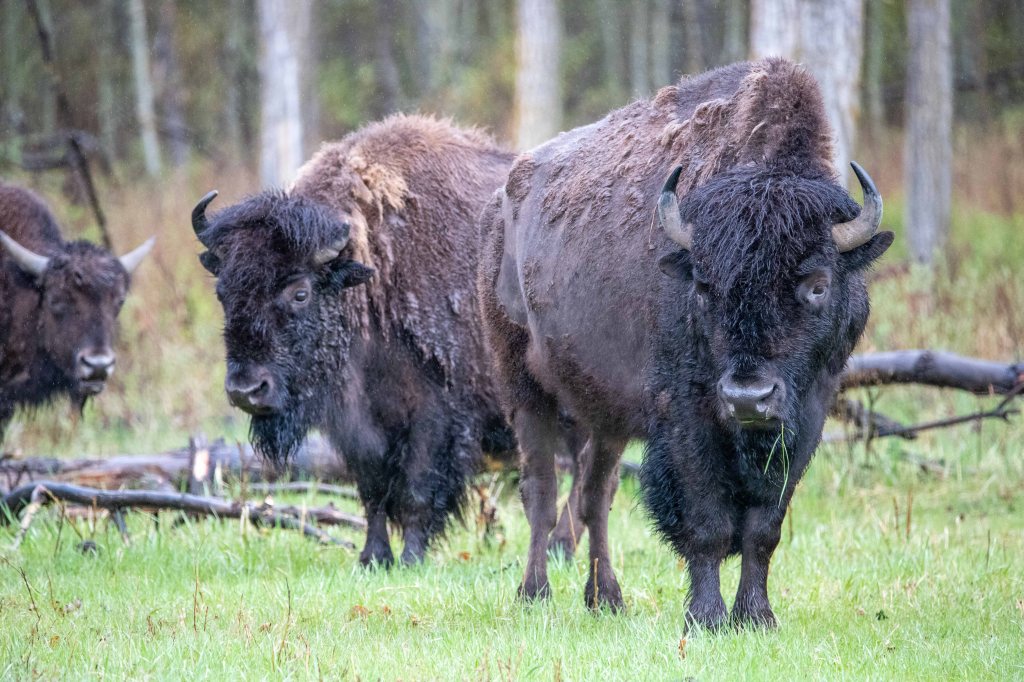
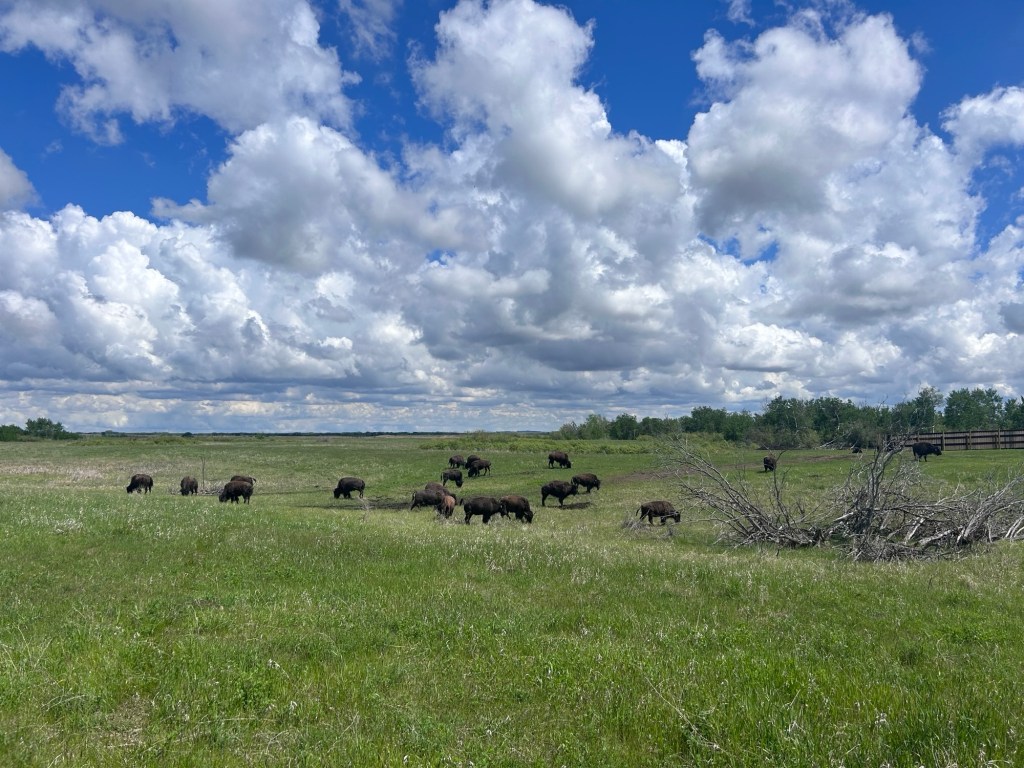
I finally did find bison in Elk Island. After a fruitless morning on foot I drove by a small herd grazing in the rain. They stopped and stared, circumspect, water dripping off flanks and horns, ready to vanish once more into surrounding timbers. I had to respect their caution, descended as they were from survivors among survivors, wild animals, whom we manage from cradle to grave.
Man is a Wolf to Bison
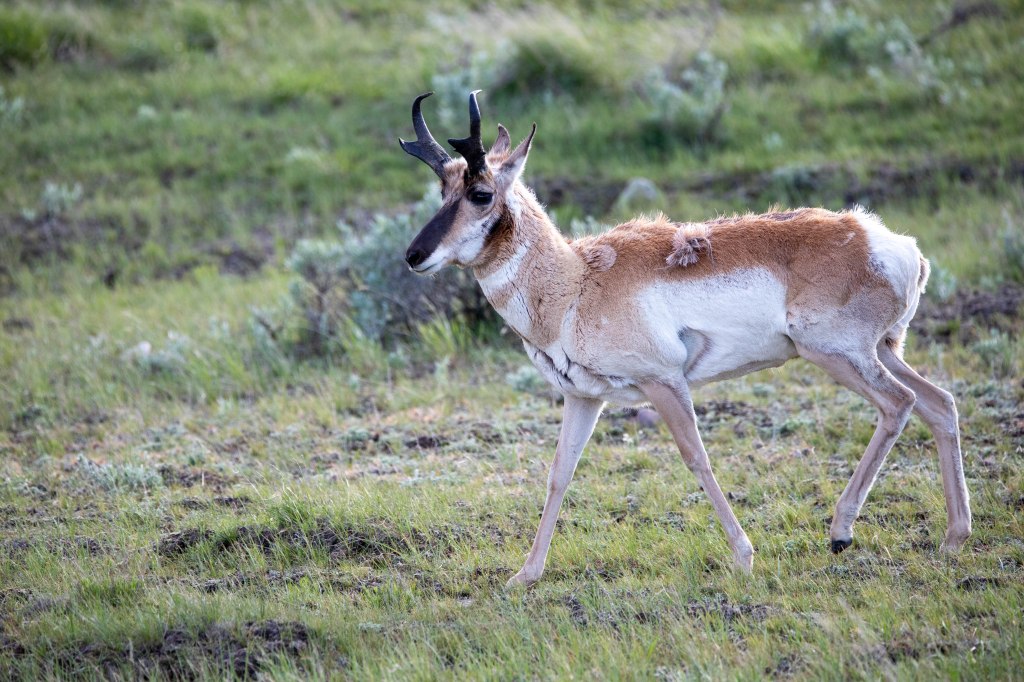
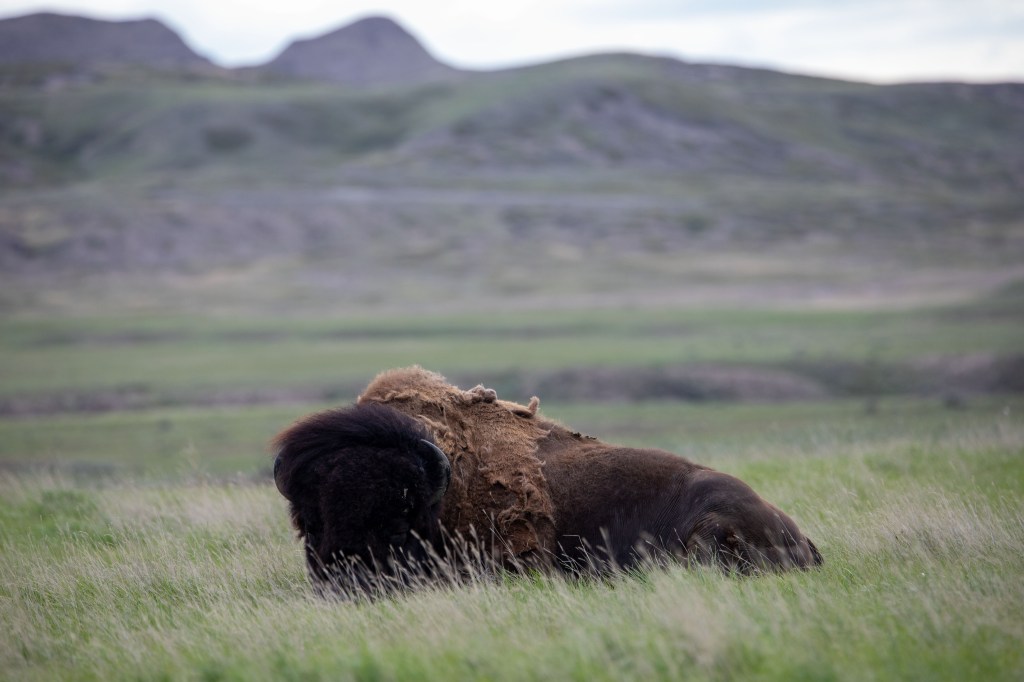
Grasslands National Park, Saskatchewan, is the archetypal prairie, its hills whipped to prearranged heights by endless wind, its valleys converging on narrow veins of freshwater, everything awash in sage and gold, everything naked for kilometres around. Here is a colony of Black-Tailed Prairie dogs, yipping vigorously from honeycombed Earth, and there a herd of restless Pronghorns, tearing across landscapes with an effortless trot. And on the banks of the Frenchman River, a lone bull.
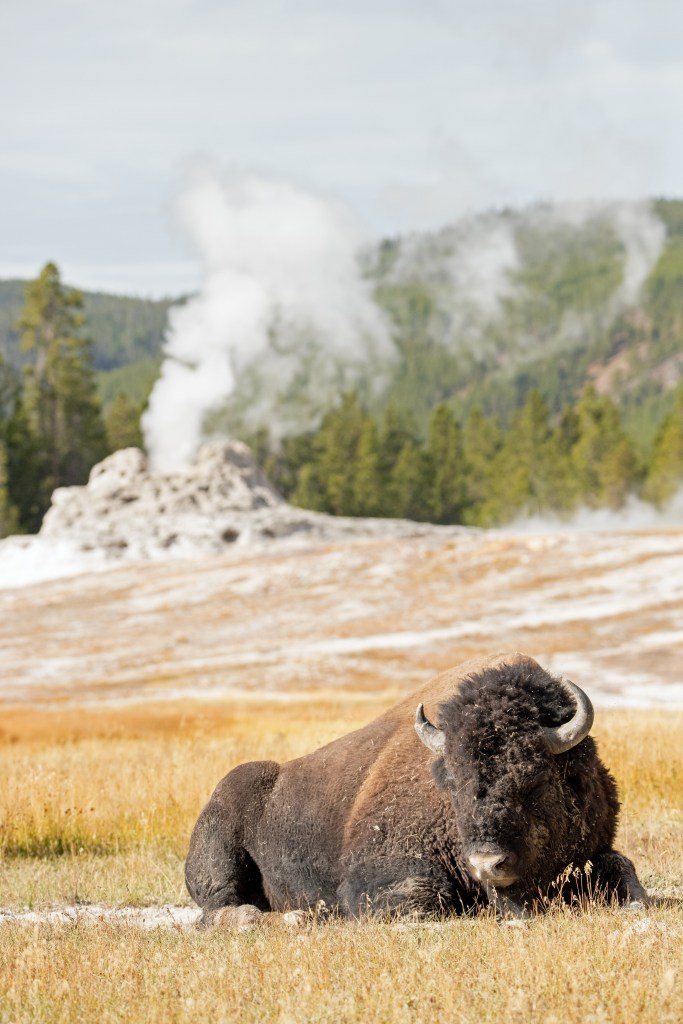
I knew at once this was a different class of bison – bigger, heavier, more regal than any I’d seen in Alberta, a coat of robust brown fur draped over a mountain of lumbering muscle. Elk Island seeded Grasslands with 71 bison in 2005, and those original 71 stayed relatively small their entire lives, stunted, however subtly, by their forested upbringing. But their children, born and raised on genuine prairie, assumed mightier dimension. They also popped out faster, bringing the herd to 400 individuals by 2013. This is when the work of Ryan Hayes, bison operations coordinator, really started.
“We want to run this as a natural herd,” said Hayes, “and natural herds would usually deal with grizzlies, cougars and wolves. We don’t have any of that anymore. So it’s our job to keep their numbers where they need to be for this landscape. If we ran too many bison, the grass would go downhill, and that would hurt everything, bison included.”
It’s a lot of work letting bison lead “natural” lives. Instead of true migrations, Hayes trained them to follow a year-long circuit of their 45,000 acre enclosure, beginning and ending at the park’s bison handling facility. Every other year, they’re culled upon arrival, the removal of animals both random and precise – random in that Hayes selects individuals without prejudice, precise in that he removes specific numbers from every age group. His goal is to mimic natural predation, which is hardest on the old and young.
“I think our herd has done a fantastic job holding onto its wild instincts,” said Hayes, “but we do have to gather them, we do have to handle them, and we do have to bait them.”
He takes the herd from about 600 to 400 individuals, making very sure – like an altruistic wolf – they cannot overgraze the park. Of the 200 removed, a few of the oldest and unhealthiest are sent for “test slaughter,” confirming the absence of diseases like brucellosis, tuberculosis and anthrax from the herd. A few more are sold as livestock. But whenever possible, and just like Elk Island, their excess bison go to establish new herds. This is the primary mechanism by which Plains bison are recolonizing North America.
Aside from this alternating cull, the reality of the fence, and the odd piece of alfalfa, Hayes practices non-interference in the daily lives of bison. I could see this for myself in the lone bull on the Frenchman River, whom I discovered day after day in more or less the same place. He approached me once, slow and careful, reacting to the crunch of my boots and the click of my camera, but not to my movements. He closed the distance to a few unnerving paces and leveled his eyes in my general direction. Both orbs were milky white.
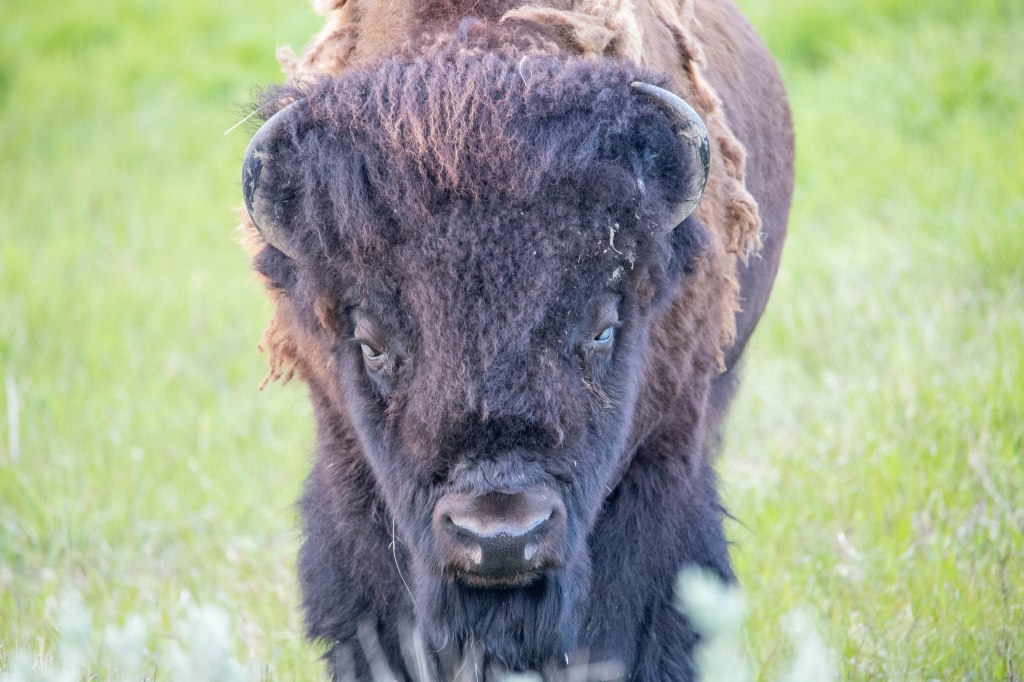
It’s a common injury among male bison, and it’s usually caused by other male bison. Unlike domestic herds, where bulls are kept to a minimum, wild herds have even sexes, and if one bull breeds 20 cows, there are 19 other bulls who won’t breed at all. This discrepancy is solved with violence.
“There are some pretty horrific fights,” said Hayes, from which discoloured eyes and hematomas often result. But if a bull can still feed itself, water itself and protect itself from scavenging coyotes, they’re left alone. He’ll consider euthanasia if injuries are mortal, but he’s seen bulls thrive on three legs and impaired vision. They are, after all, wild.
I stayed in Grasslands the final week of May, when the park’s six or seven family groups – anywhere from 25 to 125 bison each – retreat deep into the prairie to birth their calves. And yet I saw bison – the several dozen bulls who’d lost the fight for parenthood – grazing through rewilding homesteads near the trail and road. They were eating Crested wheatgrass planted for cattle a century before, and lying to rest by the ruins of old barns, since reclaimed by colonies of swallow. Most were gathering strength for breeding season, but the old bull on the Frenchman River probably wasn’t, too old and injured to keep up the fight, too content with his riverside prairie.
The Place Where Bison Jumped
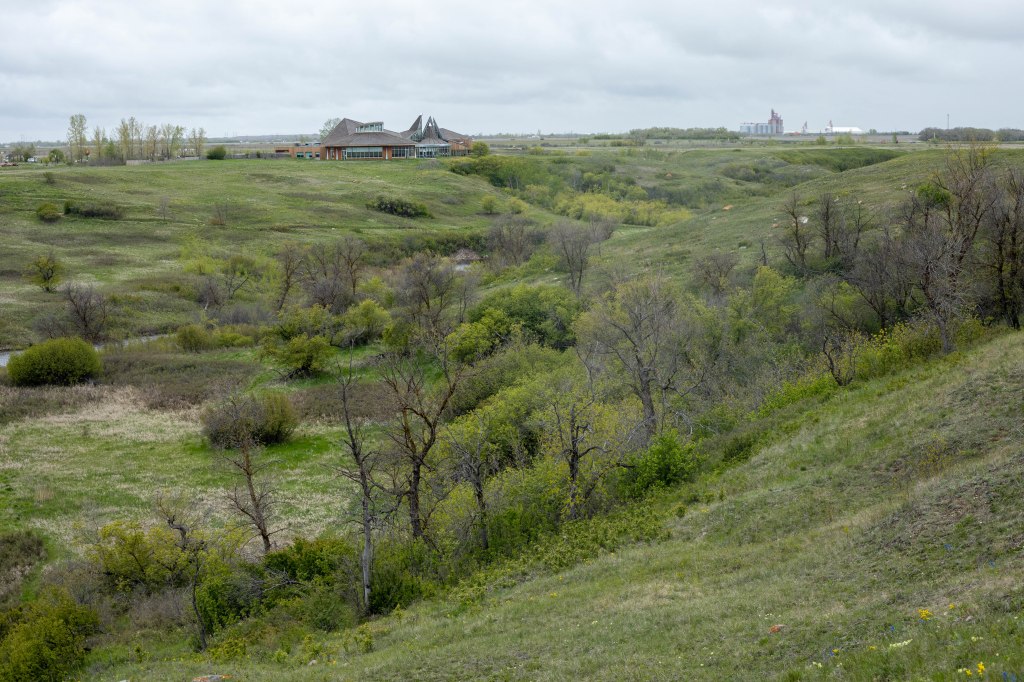
6,400 years ago, someone lit a fire in Wanuskewin. It’s the earliest act of human hands we’re aware of on this particular patch of prairie, but far from the last. Immediately northeast of modern Saskatoon, people left behind campfire charcoal, teepee rings, clay pottery, medicine wheels, petroglyphs and spear tips dated to every intervening century. More than anything else, they left behind bison bones.
Wanuskewin is the longest running archeological dig in Canadian history, lasting 41 consecutive years from the late 1970s until 2020. In that same time, Wanuskewin transitioned from a private ranch to a heritage park, with an interpretive centre, trail network, and jurisdiction over 741 acres, managed jointly by the provincial and federal governments, the University of Saskatchewan, the Meewasin Valley Authority and the Federation of Sovereign Indigenous Nations.
Vance McNab sits on Wanuskewin’s board, representing George Gordon First Nation. He is Cree, one of six plains societies whose history is told at Wanuskewin, alongside Lakota, Nakoda, Dakota, Dené and Blackfoot, they and their antecedents once running herds of bison off this park’s two “bison jumps,” steep slopes down which dozens were tricked into tumbling before slaughter.
McNab’s history with Wanuskewin is a long one. His grandfather, Hilliard McNab, was a driving force behind the park’s creation, and an early ally of Dr Ernie Walker, the archeologist who demonstrated the site’s historic value. Vance McNab even joined an archaeological dig at Wanuskewin while studying with the University of Saskatchewan. He unearthed a 2,000 year old “Besant point” on his first day, the tip of a dart used in the hunt.
“People had been digging in that spot for two weeks and hadn’t found anything,” said McNab, “so I was the miracle boy.”
The archeological record isn’t sensitive enough to distinguish one culture from another, he said, but it does show the evolution of the hunt – how these people killed and cooked bison at any given time, and how their tools and methodologies changed over millennia, from Besant points like the one he dug up, to forged arrowheads purchased from the Hudson’s Bay Company. It also shows when hunting in Wanuskewin began to dwindle, not with the eradication of bison, but with the arrival of horses to Saskatchewan in the early 1700s.
“At that time, plains people moved away from hunts where you forced bison into a trap or over a cliff,” said McNab. “Instead, you went out on your horse and caught bison any day.”
It’s easy to forget yourself in Wanuskewin. I toured its artifacts more than a little spellbound, reaching out with unconscious hands, then recoiling sharply before flesh met stone. These tools, weapons, expressions of art, show a connection with bison millennia deep, as fundamental as food to an empty stomach, as intimate as clothing in a prairie winter.
These are not understatements. One need only read reports of mass starvation from the 1870s, when at last bison departed Alberta and Saskatchewan. One report from Edmonton House, Alberta, written in 1879, was especially clear in my mind as I lingered over shattered pots and beaded moccasins. “No buffalo,” it reads. “All on the plains [are] starving.” It’s only fitting, I thought, that First Nations bring bison home to Wanuskewin.
“Even in my grandfather’s time,” said McNab, “back in the early 1980s, they were talking about bringing bison here.”
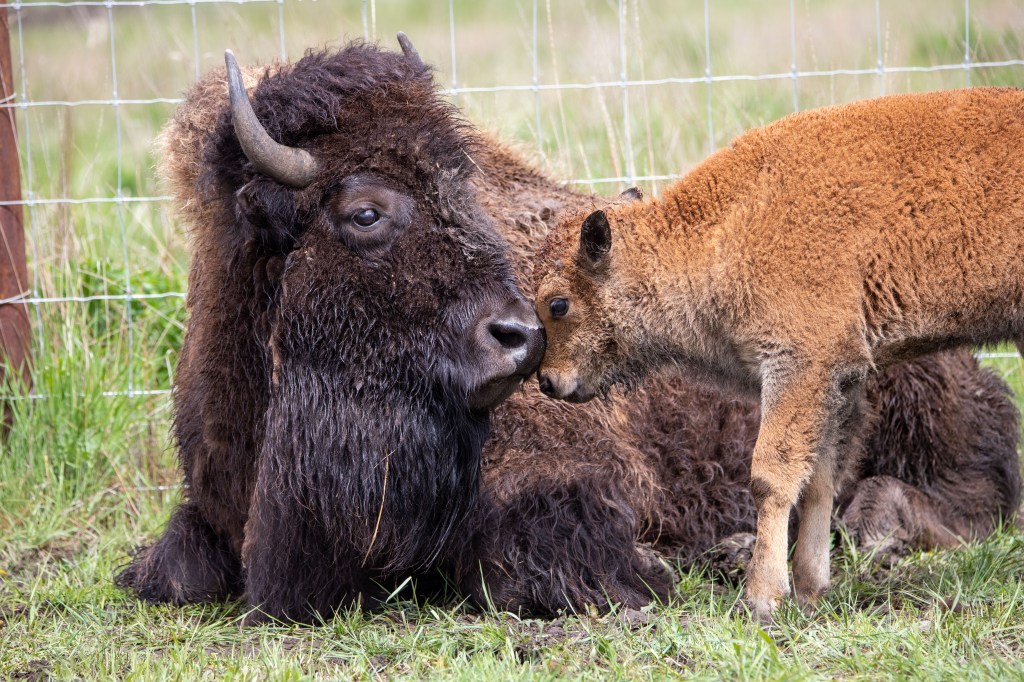
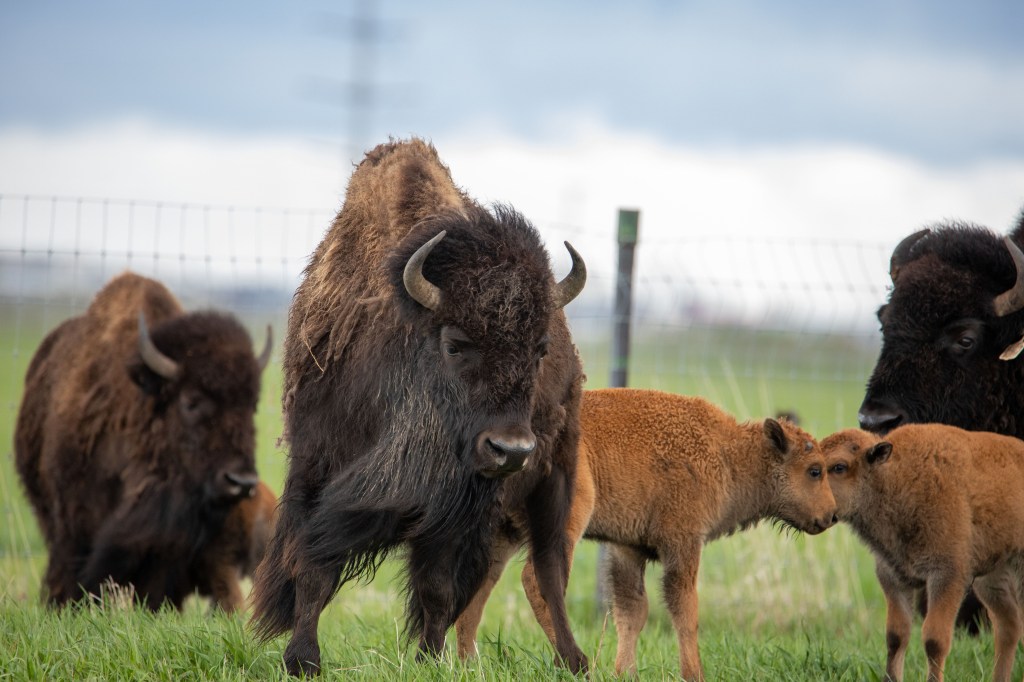
It took time, money, and the acquisition of land, but on December 7th, 2019, six Plains bison from Grasslands National Park made landfall in Wanuskewin. Only ten days later, another five arrived from the United States, descended from the herds of Yellowstone.
“It sort of completes the story,” said McNab, “especially for the First Nations, who, all their lives, heard of how their ancestors survived on bison.”
In this regard, Wanuskewin’s no longer unique. With the return of traditional territories to indigenous peoples across the Great Plains, these same peoples have become champions of bison reintroduction. More recently, the Métis have been on the move.
“We’ve wanted to reintroduce bison to the land for quite some time,” said Michelle LeClair, vice president of the Métis Nation of Saskatchewan. “We are the bison people. It was a no-brainer.”
In 2022, 1,700 acres were returned to the Métis Nation in and around the Batoche National Historic Site, and by 2023 – with help from Parks Canada and Agriculture and Agri-Foods Canada – bison roamed the land. Their enclosure will eventually number 500 acres, and the herd will grow to a hundred individuals.
The Métis haven’t decided what to do with excess bison when the herd inevitably grows beyond capacity, but they have more territory, and other reintroductions are very much on the table, perhaps near Fort Qu’Appelle, said LeClair, or north of Prince Albert. Her only regret is that there’s so little land to give, relative to the historic range of bison.
“That’s the way it should be,” she said, “with wild herds on larger landscapes. We just don’t have the land. For us and for First Nations, who are really leading the charge, this has been our first opportunity to have bison return.”
Thinking Bigger
Bison face the storm. It’s a very old saying, and it’s meant literally. If clouds darkens the horizon, raining buckets on the next prairie over, bison will turn in that direction, staring wistfully at distant skies. This curious behaviour has lead some researchers – landscape ecologist Hila Shamon among them – to hypothesize that Plains bison, like African wildebeests, track storm cells, making mental note of where the best grazing will soon be. The problem with this hypothesis is that it can’t be tested. If this is a part of their biology, no modern enclosure is large enough for them to express it.
“The species is being reintroduced and rewilded in some very large parcels,” said Shamon, “but their movements are still constricted. We don’t have any truly wild, free-roaming bison anywhere in North America.”
If you tally up all the “conservation herds” on the continent – herds explicitly established to preserve the species under more or less natural conditions – the grand total is about 25,000 head. This is a far cry from the 25 million of the early 1800s, and if you tally up their enclosures, they roam about 0.5 per cent of their historic range.
This is a problem, for land as well as bison. Without large grazers, grasslands overgrow and smother themselves, and while cattle fill this niche admirably, there are important differences between these two ruminants. Bison shed great coats of fur, which are woven into nests for kilometres around, both for warmth, and to mask the scent of chicks from predators. Bison also wallow, compressing the soil to form ephemeral ponds ideal for sensitive species of amphibian and wildflower. Their manure fosters kingdoms of dung beetle, nourishing soils and insectivores both, and in places like Wanuskewin, bison have even been recruited in the destruction of invasive weeds, and the spread of native seeds.
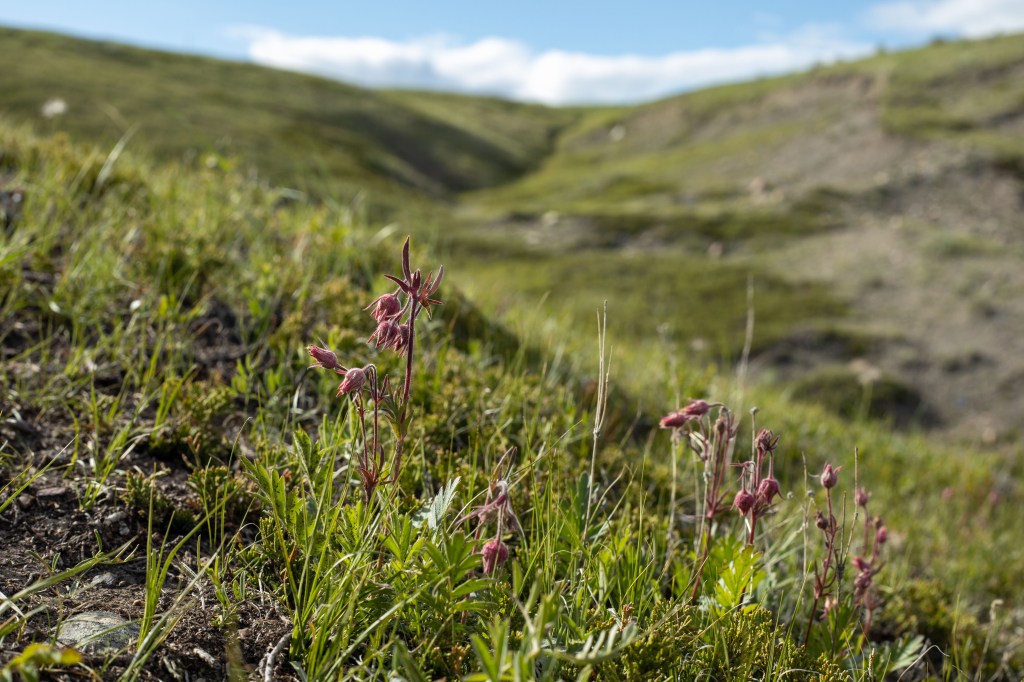
And then there’s grazing. Shamon has been scrutinizing adjacent grasslands in eastern Montana since 2018, some with bison, some with cattle. Among other things, bison are more mobile, grazing their grasslands into uneven mosaics with a wider variety of habitats. They’re also less dependent on water, straying farther from streams and rivers, and leaving their banks more vegetated. This means cleaner water and more reliable wildlife corridors. But for all the acres returned to Plains bison, and all the ecology they’ve set back into motion, their influence doesn’t reach far past the fence.
“Right now,” said Shamon, “Plains bison are ecologically extinct.”
We don’t know how much land bison need for truly natural lives, or to restore truly natural prairie. How far they’d migrate or graze or chase storms without a fence in their way is the “million dollar question,” said Shamon, and to answer it, she’s tracked bison herds in 25,000 acres enclosures. These giants were in constant motion, perpetually bouncing off the fence.
“Like bees in a jar,” she said.
Indigenous reintroductions like Wanuskewin and Batoche can have enormous cultural value, said Shamon, but are presently too small and scattered to make an ecological dent relative to the Great Plains. Larger reintroductions, in Elk Island, Grasslands, even the 300,000 acres enclosure in Banff, likely fall short. The best bet for bison, she said, is probably American Prairie.
In eastern Montana, the American Prairie Foundation is purchasing private land between the Charles M Russell National Wildlife Refuge and the Upper Missouri River Breaks National Monument, connecting these and other federal lands to create a continuous 3.2 million acre wildlife corridor, through which they hope to run Plains bison acquired from Elk Island National Park in 2009. If achieved, this so-called American Prairie Reserve could support a truly wild herd of 10,000 Plains bison. At these scales, American Prairie is the only game in town. “If our goal is wild bison,” said Shamon, “behaving naturally on natural landscapes, then we need to think much bigger. We need to be more ambitious, even if that means making things more complicated. I’m sure there’s room in North America for bison. We just need to make space.”
Zack Metcalfe is a freelance journalist, columnist and author based in Salmon Arm, British Columbia. This article was originally published with Rewilding Magazine.

 The Wandering Rook
Leave a comment