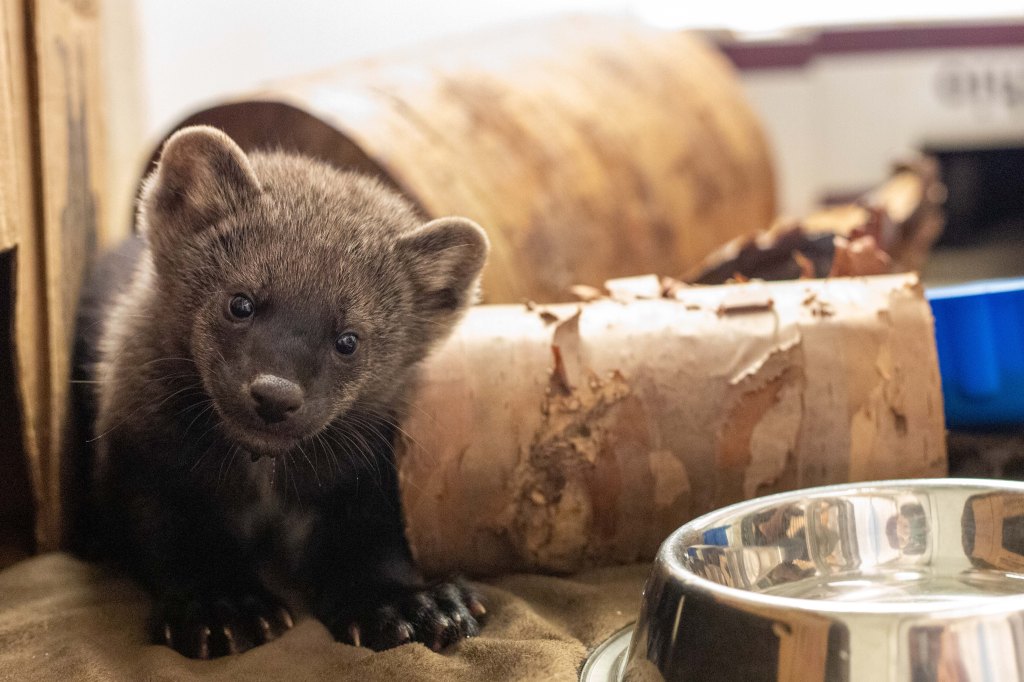
In 1976, mammologist Roger Powell watched a fisher kill a porcupine.
Confronted with most predators – wolf, coyote, lynx, bobcat – the porcupine is unassailable. It needs only turn its back, allowing a rosette of 30,000 quills to protect its vulnerable face, and if the predator persists, it can tuck that face into any nook or cranny, like the base of a tree, or interior of a hollow log. Failing that, it swings its tail like a medieval flail. This simple strategy keeps porcupine off the menu more often than not, a staple in the diet of no North American carnivore, save one.
The fisher was relentless, said Powell, running circles round its prey faster than the porcupine could turn, darting in to bite the face and leaping away to avoid the quills, slowly but surely wearing its victim down. When the porcupine sought cover, the fisher ran ahead, leaping onto rock or tree or fence and holding itself in place, upside-down like a squirrel, turning the porcupine back. The aftermath of such encounters, said Powell, are near perfect circles of padded snow covered in blood and quills, the porcupine pivoting desperately in the centre, the fisher orbiting fleet of foot.
What struck him most wasn’t the frantic motion, but instead the intermissions, when the fisher ceased its dogged sprint to “assess the situation,” usually from a distance. But once – to Powell’s amazement – the fisher approached, reaching head and torso overtop the porcupine to sniff the air immediately above its rosette, well within the range the tail.
“When that tail snaps,” said Powell, “it drives quills into the skin. Porcupines fill a bobcat’s face or a coyote’s face or a wolf’s face with quills all the time.”
Powell has himself become a human pincushion, stuck with quills so deep they could only be excised with pliers, but the fisher’s a very different beast, adapted to exactly this prey. Not only does its skin absorb and dissolve quills without infection, the fisher also has one of the fastest burst speeds of any animal in the western hemisphere. When the tail finally did snap, the fisher avoided its quills as casually as might a hummingbird, an exhibition of speed Powell has never seen before or since. The end came shortly thereafter.
This fisher was two years old, hand-raised by Powell since her birth in 1974. Her name was ThaCho, and this was the first porcupine she’d ever seen. No one needed to teach her how to do this.
The Biggest Weasel You’ll Never See
Fishers don’t fish. They hardly even swim. How an arboreal weasel, living off squirrels, hares and porcupines, came to be called “fisher” is an enduring mystery, and goes some way to explaining why most people can’t put a face to the name.
They’re kin to martens, except larger, longer, stockier, and somehow, even more shy, avoiding human beings so scrupulously that few will ever see one. Biologists have spent careers on fisher, and come away with only a few genuine sightings, unaided by trap or radio tag. Powell, who literally wrote the book on fishers in 1980, and who’s studied them in Minnesota, Michigan, California and elsewhere since 1972, has stumbled on fewer than a dozen.
“Fishers are interesting in that they’re both generalists and specialists,” said Powell.

They thrive at the intersection of mature, intact forests and a healthy population of porcupines, using the structural complexity of the former to hunt, hide and give birth, and their near monopoly over the latter to stay fed, even when all other prey species fail. But take these specialties away – by degrading forests or destroying porcupines – and the fisher becomes a generalist, shifting its diet, wholesale, to whatever’s available, be that mice or woodpeckers, and resorting to imperfect trees, from the standing deadwood of recent forest fires to the mature oaks of urban parks. Some fishers have even gone vegan, carnivores subsisting on wild apples and berries.
“We don’t think of specialists as being able to survive where their speciality doesn’t exist,” said Powell. “Fishers are flexible enough to hang on.”
Unless you start trapping them. The great irony of fishers is that, for all their reclusively, they’re very easy to trap, and where populations already struggle for lack of mature forests and porcupines, they’re very easy to eradicate.
This is precisely what happened in the late 19th century, and throughout the 20th. Fishers are native to every province with the exception of Newfoundland and Labrador, ranging as far north as the Yukon, and as far south as California in the west and Georgia in the east, with strongholds throughout the Boreal. The loss of habitat to agriculture and forestry across their range left fishers vulnerable by the early 1900s, and when the value of their pelts spiked in the 1920s, unregulated trapping all but exterminated the species from the United States. By the 1940s, only six remnant populations remained south of the border.
By that time they were exceedingly rare in the Canadian south, and especially the Canadian east, devastated in Ontario and Quebec, gone from New Brunswick but for holdouts on the Cumberland Plateau, and absent from Nova Scotia entirely. By some estimates, fishers lost 40 per cent of their historic range, and remaining populations were mighty thin.
“Either trapping or habitat destruction by itself could have dramatically reduced fisher populations,” said Powell. “Together, their effect was extreme.”
The One That Got Away
In 1988, wildlife biologist Gilbert Proulx – now director of science with Alpha Wildlife Research & Management in Sherwood Park, Alberta – went in search of a humane fisher trap. Most on the market fail to kill fishers quickly, he said, resulting in undue suffering, while some, like steel leghold traps, maim fishers without necessarily catching them.
“I remember a fisher we live-trapped in the Lac La Biche area,” said Proulx. “He only had one paw, losing the other three to leghold trapping.”
He and colleagues decided a modified Bionic quick-kill trap showed the most promise, but demonstrating the effectiveness of their design on fishers required a necessary evil – killing some in a controlled experiment. That year, several dozen were recruited from healthy populations in northern Ontario and Manitoba, and work began.
The modified trap performed as expected, time and time and time again, until a male – fisher 954 – walked away from its deathblow. An examination showed he was in perfect health, his skull intact despite the whack, so Proulx and colleagues returned to the drawing board. The trap was strengthened and trials resumed, but they didn’t get very far. 954 survived again, and while the trap held him down a short time, he managed to thrust his torso deeper into its jaws, then literate himself entirely with a backward twisting motion. Once again, the trap was redesigned.

“That fisher was a small bear,” said Proulx. “He’d paid his dues, so I decided to return him to the wild.”
But first, Proulx agreed to loan 954 to researchers in Washington State, with the strictest understanding that this remarkable fisher be returned to Alberta, unharmed, for a wild release. These terms were agreed to, and the miraculous male boarded a plane at Edmonton International Airport.
Fisher 954 never made it to Washington. He escaped his cage before takeoff, reduced the plane’s wiring to copper spaghetti, then bolted to freedom through an open door at 2am. Proulx and colleagues tracked him through the suburbs of Leduc for days, following a trail of eviscerated birdfeeders and champed suet, before finally admitted defeat.
“In the end,” said Proulx, “he made it to the wild on his own. That fisher was a survivor.”
Homecoming
Proulx eventually made good on his promise of a wild release. 954 had flown the coop, but he still had 17 fishers in captivity when his experiment was successfully concluded. And as surely as day proceeds night, these 17 fishers started having kits.
In 1990-91, he released them 25 kilometres east of Edmonton, into Elk Island National Park, the Cooking Lake-Blackfoot Provincial Recreation Area, and the Ministik Lake Bird Sanctuary, places they’ve been absent some 50 years.
“In those days,” said Proulx, “fishers were a very rare species in Alberta, devastated by trapping and strychnine poisoning.”
This was by no means the first fisher reintroduction in North America. That honour goes to Nova Scotia in 1947-48, when 12 were set loose in the province’s southwestern. Since then, fishers have been reintroduced to most of the states from which they were eradicated – Wisconsin, Vermont, West Virginia, Connecticut, Pennsylvania, Tennessee, Michigan, Massachusetts, Montana, Oregan – and the provinces of New Brunswick, Ontario and Manitoba have each moved fishers from north to south, seeding new populations from old. But Proulx’s reintroduction was one of the most successful. And unusual.
By 2013, fishers were well established in the “forested island” he’d chosen for them, 400 square kilometres of protected parkland in an ocean of farms, but when this population was genotyped in 2014 and 2016, it was found that Proulx’s original 17 animals contributed remarkably little to the modern genepool. Its expected ancestorial ties to Manitoba and Ontario were dwarfed by genes from remnant populations far away in northern Alberta.
Proulx explains this phenomena with a bit of fisher psychology. When it comes time for mothers to expel their kits, he said, they’ll typically chase sons farther away than daughters. The result is that females establish ranges closer together, while males search farther afield. And what are they looking for? Females. Proulx surmises that his reintroduced population – especially its female nucleus – began soaking up wandering males from elsewhere in Alberta. Lots of them.
“Our fishers succeeded,” he said, “and somehow this enticed fishers from elsewhere to come and establish themselves.”
This project taught Proulx several things. Firstly, that fishers are active – even enthusiastic – participants in their own reintroduction, the mass immigration east of Edmonton being just one example. Those loosed in southwestern Nova Scotia in the 1940s reached the far end of the province – Cape Breton Island – by the early 2000s, and those dumped in northern Michigan in the 1960s are already popping up in Iowa. Reintroduction projects have scattered them like breadcrumbs, and while much of their spread is too tenuous to consider “established,” fishers are, nevertheless, filling in the gaps on their own.
“I come from an area north of Montreal,” said Proulx. “As a kid, I never encountered fishers there, but now, people encounter them all the time. They’re spreading, and it’s a good thing. In many ways, they’re getting back their land.”

Something else he learned is that habitat type matters much less than habitat quality. Fishers will adapt to different forests in different ways, and the survival of a given population depends on the forest features they happen to be using. This was on display in the early 1990s, when those he released in Elk Island National Park left in favour of the adjacent Cooking Lake-Blackfoot Provincial Recreation Area. At that time, said Proulx, Elk Island’s understory was overgrazed by herds of elk and bison, and in aspen forests such as these, fishers depend on robust understories to hunt Snowshoe hare. This is in sharp contrast to British Columbia, where greater snowfall routinely buries the understory, and fishers rely on intact overstories to keep moving in winter.
This helps explain why most fishers are gaining ground while some continue to collapse. Perhaps the greatest limiting factor to population growth is the availability of tree cavities, the one and only place females will build dens and give birth. Such cavities only develop in trees of sufficient age, but “sufficient age” varies from one tree to another. Deciduous species like aspen might cavity within 80 years, while coniferous trees like Douglas fir might take 300. Harvest rotations of 100 years, therefore, are more catastrophic to fishers in some forests than others.
“I personally believe they’re secure in most areas,” said Proulx, “but there are exceptions, like in southern British Columbia.”
A Necessary Tumble
On June 7th, 2024, Larry Davis was called about three fishers stuck in a tree. They were kits, just a few months old and entirely dependent on a mother who died the day before, probably killed by a bobcat.
In any other circumstances, nature would have taken its course, but the mother was part of a fisher telemetry project through Thompson Rivers University, her movements recorded and transmitted via radio tag. Graduate student Shannon Werden knew something was wrong when the mother didn’t move 24 hours straight, and found her remains shortly thereafter. Werden also knew where to find the den, a little west of 100 Mile House, British Columbia.
“We were a bit frantic,” said Davis, a semi-retired fisher biologist based nearby.
The kits were alive, but 43 feet off the ground, nestled in the cavity of a very dead aspen with no obvious way up. Davis and Werden called in professional fallers to make the climb, but the fragmenting trunk couldn’t support a human being above 15 feet. The only solution was a risky one – cut down the tree.
“We felt it was worthwhile,” said Davis. “They hadn’t had their mother in 48 hours at that point.”
Cables were attached to ease the fall, but came loose, and the tree landed hard. Davis and Werden could hear the kits squealing inside, and peeled away the fibres of the den with bare hands.
“They weren’t hurt,” said Davis, “just a little dehydrated. That’s the most sound I’ve ever heard fishers make.”
11 Years
At one time, the “Columbian fisher” was continuous throughout Interior British Columbia, and down to The Cascades in Washington, a population made physically and genetically distinct by 20,000 years of separation from their cousins in the Boreal, kept apart first by glaciers, now by The Rockies. They, too, retreated north from logging and trapping, restricted now to the Fraser and Chilcotin plateaus of BC’s Central Interior, but unlike fishers in the east, their collapse is very much ongoing.
This remnant population began its final dip in the mid-2000s, said Davis, after outbreaks of Mountain pine beetle tore through their habitat. The mass death of trees bothered fishers very little at first – they use deadwood as readily as living – but then came widespread salvage logging, removing all woody structure.
“They really went to town,” said Davis. “It’s amazing to fly over some of these areas, especially the Chilcotin, where entire valleys have very little forest left. It was a sensible economic policy, but bad for animals that need extensive forest cover.”

Rory Fogarty, a wildlife biologist with Consus Management, conducted surveys in the Chilcotin and Fraser plateaus from 2018-21 on behalf of the provincial government. His published conclusion was that the Columbian fisher, with an estimated population of 299-517, would disappear in 11 years under current conditions. That was two years ago.
“These are numbers that weren’t fun to find,” said Fogarty.
The population has fallen so low, he said, that a relatively modest number of trappers – maybe 300 – have been enough to hasten its collapse. The loss of adult females in particular, and in traps set for mink (there’s no fisher trapping season in BC), is how Fogarty arrived at his 11 year estimate. Remove trapping losses from his analysis altogether, and he still predicts the extinction of the Columbian fisher in 37 years (now 35).
“Fishers in the Central Interior seem to be really closely tied to their habitat, more so than fishers in the Boreal,” said biologist Rich Weir, former carnivore conservation specialist with the BC provincial government, now with Artemis Wildlife Consultants. “They’re impacted way more by logging, because our forests glow back differently, and so do the features these fishers use.”
Preserving the Columbian fisher would require a very different approach to logging in their range, he said. Identifying and avoiding the scraps of habitat they’re presently depending on would be a start, followed by broader management practices which keep complex woody structures on the landscape.
In the meantime, said Fogarty, the Columbian fisher cannot handle trapping at any scale. British Columbia could follow the lead of Washington State, he suggested, and transition to strictly live-trapping, so target species can be kept, and by-catch, like fishers, set free. At time of writing, these changes hadn’t been mandated by the provincial government.

The future of the Columbian fisher is a very uncertain one, said Davis, and interventions beyond logging and trapping might he necessary, like the broad installation of artificial den boxes, holding females over until habitat recovers. He experimented with such boxes from 2013-2018, and they show promise. Then there’s reintroduction, and in this way, BC has an insurance policy. Columbian fishers have been used to establish populations in Washington, Oregan, Montana and Idaho in decades past, some of whom could, conceivably, donate fishers back.
“We helped expand their range with the hope that, some day, Columbian fishers from The Cascades could move back into southern BC,” said Davis. Since their rescue, the three orphaned kits of 100 Mile House – two males and one female – have been in the care of the BC Wildlife Park, where they’ll stay at least until autumn, and perhaps their entire lives. On one hand, they’re members of a critically endangered population in sore need of breeding adults, and on the other, very little habitat awaits them in the Central Interior. Keeping them in comfortable captivity might mean keeping them alive. It might also mean wasting their inborn gifts for adaptation. Today they accept veterinary care with the docility of kittens, but tomorrow they could stalk porcupines like ThaCho, or outsmart traps like 954. Such is the way of the fisher.
Zack Metcalfe is a freelance journalist, columnist and author based in Salmon Arm, British Columbia. This article was originally published with Canadian Wildlife Magazine.

 The Wandering Rook
Leave a comment