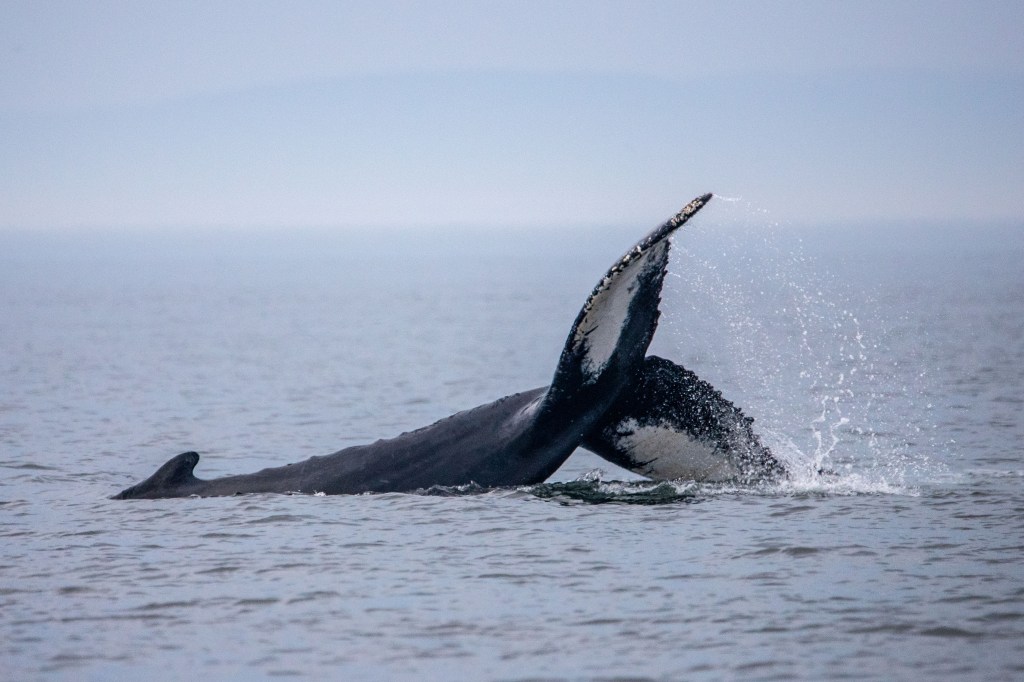
We’re not exactly sure why Humpbacks sing, and 50 years of earnest research has eliminated more theories than it’s championed.
“It seems the more we learn, the less likely our early ideas are correct,” said Jim Darling, a zoologist studying song across the North Pacific, particularly in the waters off Maui where Humpbacks breed through winter and spring.
That males sing to attract females is just such an “early idea,” and in spite of enduring popularity, Darling said this tidy explanation has never squared with observation. He’s spent time with hundreds of males supposedly serenading surrounding waters, and the only companions they ever attracted are other males, coming together for brief duets before parting ways. If a female is caught in the presence of a singing male, it’s generally because he approached her, at which point she’s liable to swim away mid-performance.
If these songs do have some reproductive utility – as is still generally assumed – the mechanisms remain obscure. Adding to this mystery is the more recent revelation that males, thousands of kilometres from their low-latitude breeding grounds, are also singing on high-latitude feeding grounds, months distant from their next reproductive prospect.
“We’re drowning in song,” said Erin Wall, a post-doctoral fellow with British Columbia’s Raincoast Conservation Foundation, a research and conservation non-profit. Since September of 2023, she’s been using the BC Hydrophone Network (17 underwater microphones on the province’s Pacific Coast) to record and scrutinize the songs of feeding males through summer and fall, the same males singing and breeding in Hawaii and Mexico through winter and spring. Her research is funded by the Mitacs Elevate Fellowship, and carried out in partnership with Raincoast, and the non-profit research organization BC Whales. Her advisor is professor Dan Mennill with the University of Windsor.

What she’s observed, in her fieldwork and in two years of back-recordings, is that song is very rare in summer, presumably because males are busy eating. But come fall, song begins to “ramp up,” fragmentary at first, but gaining in length throughout the season. This is consistent with what little research exists on feeding grounds elsewhere in the northern hemisphere, namely Atlantic Canada.
“I think,” said Wall, “this is when they’re learning the song they’ll eventually perform on their breeding grounds.”
What she’s suggesting is that males, after a summer hiatus, slowly reconstruct their song from the previous breeding season, in anticipation of the next. And since all males in a given population sing essentially the same song (albeit lightly personalized) she expects this reconstruction effort on feeding grounds is, in a sense, collaborative, beginning with playful fragments in September (3-4 minutes long), and maturing well into December (10-20 minutes long). In essence, she said, they’re practicing.
The observed lengthening of song – which she hopes to publish soon, with a few other insights – is not, by itself, all that new, but she’s also hearing an increase in song structure as the season wears on, compiling chaotic notes into orderly “phrases,” and these same phrases into broader “themes,” a trend which, perhaps, indicates the practice she’s looking for.
“Early in the season,” she said, “there’s a lot more entropy, I would say. A lot more variability. Then, as you get later in the fall, these very clear themes emerge, where you have these repeated phrases becoming more and more frequent, more stereotyped.”
This final piece remains observational, but Wall’s confident it can be demonstrated in the data with further analysis – and probably some new software – in time for publication later in 2025. In the meantime, she intends to bolster her dataset with at least one more year in the field, and perhaps two.
Darling, who isn’t associated with Wall’s research, is reserving judgement of this hypothesis until everything’s submitted for peer-review, “other than to say it seems viable, and intriguing.”
“There’s a lot not known about song and singing behavior,” he said, “and this is especially true [on feeding grounds,] so the canvas, so to speak, is wide open, and any hypothesis – as long as this term is emphasized – which may account for observations is, in my view, legit.”
Zack Metcalfe is a freelance journalist, columnist and author based in Salmon Arm, BC. A version of this article was originally published with New Scientist.


 The Wandering Rook
Leave a comment