The Upper Robson Valley, in BC’s eastern Interior, is where the Rocky and Columbia mountains meet, locking eyes from either side of the Upper Fraser River. It extends from Prince George in the northwest to McBride in the southeast, a half million hectares peppered with cutblocks and provincial parks. This is logging country, grizzly country, and the home of Chun T’oh Whudujut.
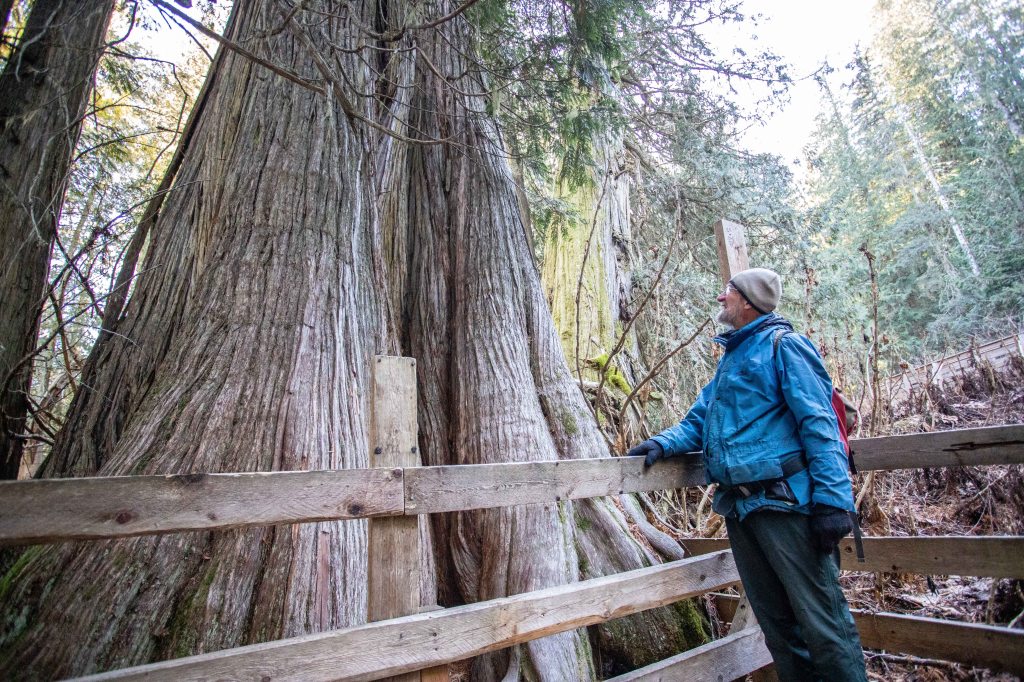
That’s what the Lheidli T’enneh First Nation call it, a Dakelh phrase meaning “The Oldest Trees.” Anglophones call it The Ancient Forest, a stand of several hundred giant Western redcedars crowded together on the eastern slope of Driscoll Ridge, a member of the Columbia Mountains.
I came in October, and like so many before me, was shocked by the abrupt transition waiting for me up this ridge. It starts like any other – a steep and shrubby climb – but then, all at once, the ground levels out for a hundred glorious metres, a thin terrace of flat soil interrupting the mountain slope, like the first step up a ziggurat. This is the “mountain bench” of Chun T’oh Whudujut, where its levialithic redcedars take root on relatively even ground.
Tree rings can only take us back so far, because the heartwood of ancient trees tends to rot away with time, but the giants of Chun T’oh Whudujut have given us over a thousand rings, clear and legible, with hundreds more lost in their hollow trunks. Some have probably grown since Charlemagne.
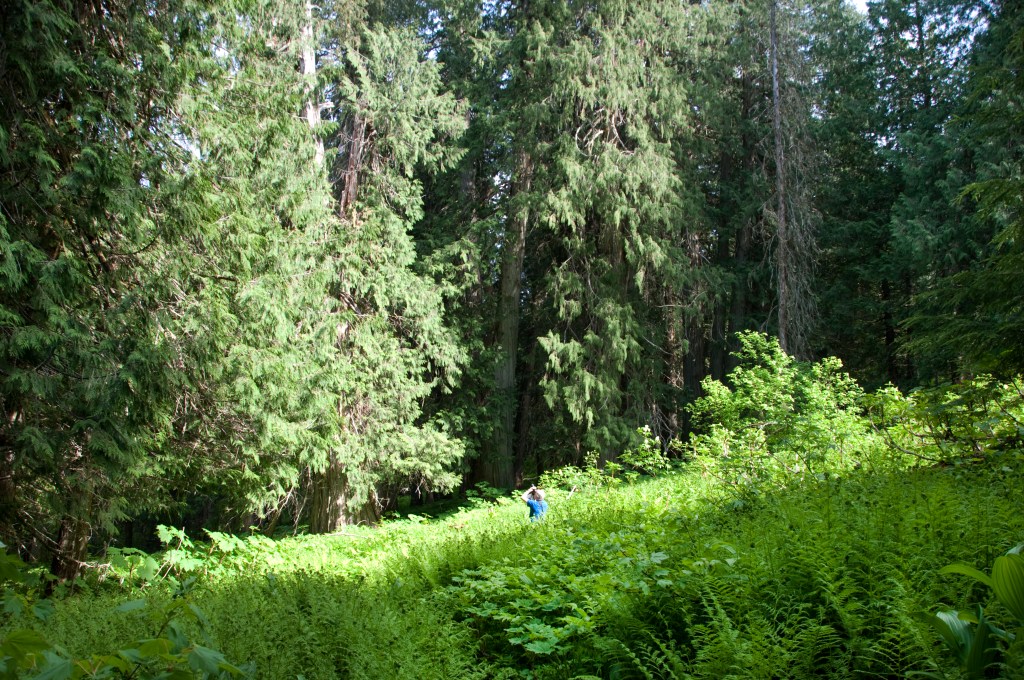
Had I come in summer, the understory would have been an impassable scrum of vegetation, with upwellings of fern far over my head, and kingdoms of vascular plant absent from any guidebook of BC’s Interior. Had I come in spring, the pit and mound topography of the forest floor would have been a network of small, seasonal ponds, a “puddle forest” clogged with bright yellow Skunk cabbage. But in late October, there were only the trees. Some were of the classic shape – 30-40 metre pillars of cinnamon gray – but others were peculiar, their enormous trunks narrowing to absurdly sharp points even before touching the canopy, like gigantic thorns erupting from the mountainside.
That small pockets of big trees lurk in the Robson Valley has been an open secret for a very long time. The Lheidli T’enneh hunted and foraged up Driscoll Ridge for several thousand years, necessarily passing over its bench, and under its redcedars. Chun T’oh Whudujut was considered for provincial park status in the 1990s, but passed over in favour of Sugarbowl-Grizzly Den to the west. In the early 2000s, the Caledonia Ramblers – a hiking club of formidable reputation – even proposed a trail through these giants and onwards up the ridge. But it wasn’t until Dave Radies, in 2004, that someone thought to look past the trees, and into the ecosystem.
His first visit to the bench was an accident. Then an undergrad with the University of Northern British Columbia, he was surveying 53 random GIS coordinates throughout the Robson Valley in search of rare lichens, and one landed him smack-dab in the middle of Chun T’oh Whudujut. The lichens he found therein didn’t belong to the Robson Valley. They didn’t even belong to BC’s Interior. Species like Smoker’s Lung Lichen (Lobaria retigera) and Cryptic Paw Lichen (Nephroma occultum) were residents of the coastal temperate rainforest on the far side of British Columbia, dependent on the precipitation and longevity of ancient places lining the Pacific Coast, and yet here they were, in the relative desert of the Robson. In the years that followed, Radies and his advisor – professor and lichenologist Darwyn Coxson – returned again and again, discovering still more species that really shouldn’t have been there, lichens and otherwise.
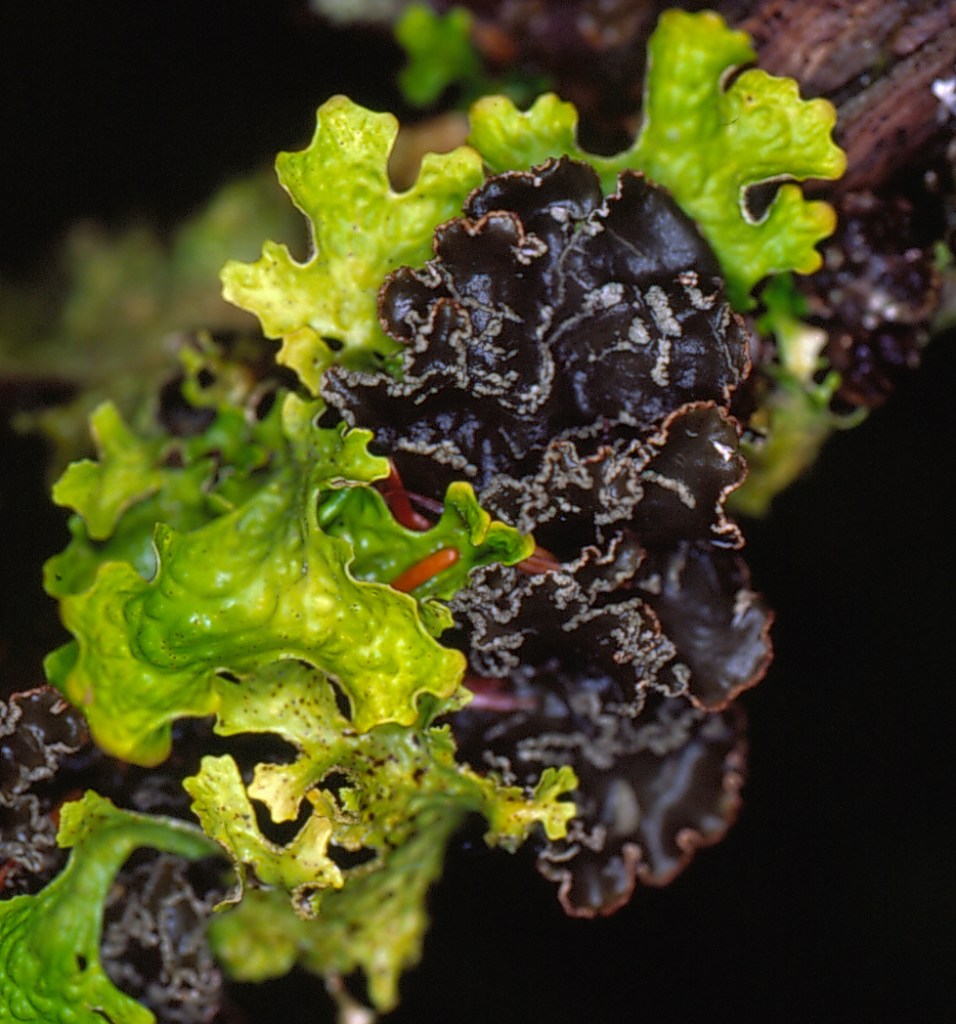
“It’s remarkable,” said Coxson, “that I’m standing in a thousand year old ancient Western redcedar stand with temperate rainforest lichens all around me, and on the horizon I can see Mount Sir Alexander, marking the start of the Boreal.”
The Boreal, too, was making contributions to Chun T’oh Whudujut. This forest’s understory, even its canopy, turned out to be a melange of sensitive species from two far flung ecosystems – the coastal temperate rainforest of the Pacific Northwest, and the Boreal east of the Rockies, coming together in an unprecedented whole.
“Side by side on the forest floor,” said Coxson, “you might have Beech fern, a circumboreal species, growing alongside Rice fruit, an iconic species of the coast.”
Their ultimate conclusion was a startling one – that here in the Robson, 800 kilometres from the ample precipitation and mild winters of the Pacific Ocean, a genuine temperate rainforest had somehow pulled itself together. And it wasn’t the only one.
Inland Archipelago
In the early 1990s, Trevor Goward, a naturalist and lichenologist in the Clearwater Valley of Interior BC, did precisely what Radies would do a decade later – he went looking for lichens, sometimes under government contract, often of his own volition. Time and again, on mountain benches, he found temperate rainforest lichens in the company of giant trees, species like Cetrelia cetrarioides, Collema auriforme and Polychidium dendriscum, never before seen so far inland. This wasn’t Chun T’oh Whudujut. These were isolated pockets of genuine temperate rainforest scattered throughout the Columbia Mountains, and to a lesser extent the Rocky Mountain Trench, some as far south as the Kootenays, and some – in fact the largest concentration – as far north as the Robson.
“At some point it became clear to me that this was an actual rainforest,” said Goward, “an actual landscape-level phenomena. Some pockets are relatively large and others relatively small, but they’re here. I started to feel a little bit like Gulliver, going to different islands and coming across different civilizations, but civilizations of lichen, not people.”
These “islands,” he realized, were cropping up in a very particular biogeoclimatic zone of the Columbia Mountains, the unimaginatively named Interior Cedar-Hemlock Very Wet Cold Subzone (ICHvk2), totalling some 1.3 million hectares. This was the ocean in which his “archipelago” of discontinuous rainforest was popping up, an archipelago he called the “Inland Temperate Rainforest,” or ITR. And somehow, it was getting by without a key ingredient – rain.

When Pacific storms sweep over British Columbia, they first collide with the Coastal Mountains, squeezed like damp towels overtop some of the largest forests on the planet. The 3,000-7,000 millimeters of annual precipitation dumped in places like Port Renfrew, Butze Rapids and Gwaii Haanas, allow their forests to grow more or less continuously for millennia at a time, and long-lived evergreens, like Western redcedar, Sitka spruce and Douglas fir, take full advantage, becoming not just ancient, but huge. The unprecedented stability of these rainforests attracts species of vascular plant, bryophyte and lichen which can’t survive in drier, more dynamic ecosystems.
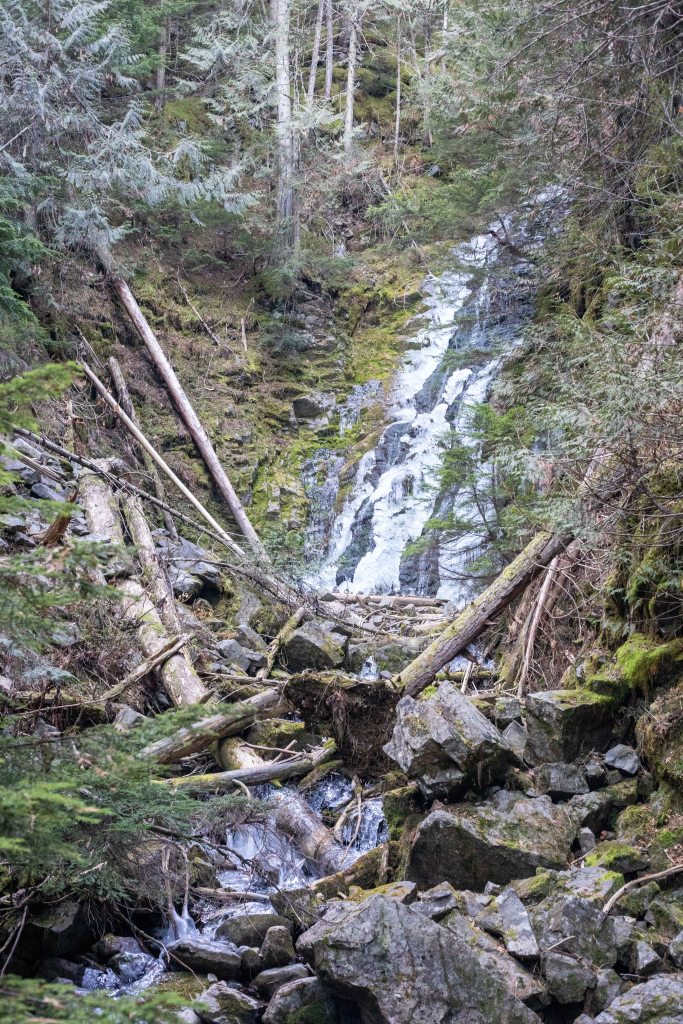
Except, apparently, in Goward’s ITR, where places like Chun T’oh Whudujut receive a paltry 900 millimetres of annual precipitation. The solution to this apparent deficit of water, Goward and others soon realized, was snow. The same storms watering the Pacific Coast eventually continue inland, gliding unopposed over the Interior Plateau and running aground in the Columbia Mountains. On these chilly peaks, their water freezes into great, high-altitude snowpacks which melt, slowly, throughout the year, a steady, reliable, downhill trickle, persisting through excessively dry summers.
It’s no coincidence Chun T’oh Whudujut grows on a mountain bench. These so-called “toe positions,” intercept the snowmelt on its way down, and, with unusually nutrient dense and clay heavy soils, they soak it up like a sponge. These inland rainforests maintain their own personal reservoirs, giving 900 millimetres the power of thousands.
The proof is in the trees. Dendrochronology – the science of tree rings – has shown the redcedars of Chun T’oh Whudujut have never known drought, helping to explain their size and longevity. Even if the Robson Valley is parched, as it has been hundreds of times over thousands of years, up to and including 2023, the combination of snowmelt and water retention keeps this inland temperate rainforest drunk and happy.
Goward became the first to conceptualize the ITR, of which Chun T’oh Whudujut was merely an appendage, but in doing so, he was also the first to appreciate how little was left. The big trees of the ITR were hit especially hard by the preceding century of intensive logging among the Columbia Mountains, especially in the south, targeted not just for their size, but also their location – mountain benches are an ideal platform for logging roads. Some of the finest ITR Goward ever studied, such as in the Upper Adam’s River Valley north of the Shuswap Lakes, were cut in the course of his research.
“Most are gone,” said Goward, “and the ones that aren’t gone are the ones that somehow got made into provincial parks, and the ones loggers couldn’t get too.”
Uphill and Down
Since 2016, botanist Curtis Björk has been working on a formal inventory of the Robson Valley’s flora, in and around Chun T’oh Whudujut, throughout Sugarbowl-Grizzly Den Provincial Park, in the thousands of hectares of wetland bordering the Upper Fraser River, and, of course, in several distinct stretches of ITR, often at the behest of the University of Northern British Columbia.
“We were astonished just how much turned up,” said Björk. “There was far, far higher species richness than what I think anyone would have expected.”
He’s kept a running tally, identifying 2,400 species of vascular plants, bryophytes and lichens to date in the Robson Valley, some of whom are probably new to science, and while the inland temperate rainforest makes significant contributions to this total, not all species are crammed beneath giant redcedars. These rainforests spring up in rich and fortuitous landscapes, so end up with rich and fortuitous neighbours.
“Tufa mounds” are just one example, calcareous pillars about two metres tall, erupting with nutrient dense water like miniature volcanoes. They form extraordinarily rare wetlands here and there in the Robson Valley, and are fueled by the exact same snowmelt watering the mountain benches far above. Their accompanying “gardens” have already yielded a new species of Yellow Monkey flower.

In 2023, Björk brought this work into the Walker Valley, an extension of the Robson. This is one of the largest intact watersheds left in BC’s Interior, neither logged nor protected, and identified by Darwyn Coxson, Trevor Goward and others as one of the few remaining strongholds of BC’s ITR. Even after years in the Robson Valley, the Walker far exceeded Björk’s expectations.
“I have to admit,” said Björk, “I thought the biodiversity of the Robson Valley was pretty much known by the time I started Walker.”
But this lone watershed was a world unto itself, distinct from the remainder of the Robson in its geology and biodiversity. He found the moss Codriophorus ryszardii, and lichen Pilophorus robustus, coastal species previously unknown from the ITR. He found Multiclavula muscida, a lichen dependent on truly ancient forests, and Pellaea gastonyi, a fern with a very restricted global range. Björk spent the winter of 2023-2024 bent over his microscope, identifying new species for his growing inventory.
“I keep having the experience at my desk of, oh, hello, what are you doing in the Robson Valley?”
The Robson is a biodiversity hotspot, he said, a tapestry of ecosystems which aren’t so easily disentangled. In the Walker Valley, for instance, he came across a limestone cliff half blasted for road materials. On the unblasted half, he found a robust community of rare and unusual species, including the aforementioned Pellaea gastonyi.

“If BC Timber Sales allows cutting in the ITR upstream from there,” said Björk, “that’ll require new sideroads and road repair, which means that cliff will likely yield even more road material than it has in the past. So, the fate of the rainforest up that valley is closely tied to the fate of that limestone cliff.”
Wetlands adjacent to, or surrounded by, the ITR will likewise share its fate, said Björk. If the ITR is cut, the hydrology of its neighbouring wetlands will change significantly, perhaps to the detriment of its more sensitive species.
There’s also the action of invasives. If new logging roads are blazed into Walker Valley, said Björk, invasive hawkweeds will soon follow, invading disturbed and undisturbed ecosystems both. Then there’s Cirsium palustre, the European Swamp thistle, which he fears will swarm the Walker Creek.
“This one’s a real gamechanger,” said Björk. “It’s not often seen in most parts of North America, but for some reason, in the Robson Valley, it’s really abundant and spreading fast. Once it gets into wetlands, it can account for as much as 50 per cent of vegetation. Some of these European invasive plants are better adapted to disturbance than our native flora, and there’s no disturbance like clearcutting and road building. Play things forwards a hundred years, and we’ll lose a lot of our native species.”
The Lucky Third
In Chun T’oh Whudujut, the trail saved the trees. Logging was underway when Dave Radies arrived in 2004, with outlying redcedars already on the ground. The core of the forest would soon follow, so Radies asked the Caledonia Ramblers for help. In reply, they built the Ancient Forest Trail – a raised, accessible boardwalk following a line of mighty redcedars out and back, with an adjoining loop leading to some of the finest individual trees. There’s Radies Tree, more thornlike than most, and Treebeard, in homage to JRR Tolkein. Big Tree, as its name implies, is a god among insects, dwarfing its neighbours with a diameter of five metres. And lying, suspended, overtop the trail, is Lofty, an enormous trunk under whom hikers must duck.

The Ancient Forest Trail promptly attracted tens of thousands of people a year, many of whom questioned the wisdom of cutting redcedars the approximate age of the Holy Roman Empire. The trail allowed educational tours, and empowered researchers with the University of Northern British Columbia to build their case, not only for the site’s ecological value, but also its tourism potential. The Lheidli T’enneh First Nation lent their voice and bargaining power to negotiations with the provincial government, and in 2016, Chun T’oh Whudujut became a provincial park.
“A whole bunch of stuff had to happen independently for there to be a park here,” said Coxson, “and it barely happened in time to save what you see today.”
Evidence of this near miss is spraypainted on the trees – the cryptic numbers and dashed of the logging industry. I saw them everywhere during my hike, and tried to imagine the sorts of stumps Big Tree or Radies Tree would have left behind. The trail doesn’t touch on the parts that were cut, but I’ve seen pictures, of people standing tall on gigantic, felled trees, not merely cut, but left on the ground to rot.

Darwyn Coxson joined me on my hike, pointing out the subtler features of an overwise grandiose ecosystem. There was the tree obliterated by a lightning strike, whose flame couldn’t spread in a forest so wet. There were the “ice flowers,” where the continuous flow of water beneath the forest occasionally frozes, erupting from the soil as a coil of tiny currents, like transparent licorice. There were the cavities in the giant trees, some large enough for a grizzly to squeeze inside and take a nap.
Many factors are working against the ITR, he said. The climate is shifting in BC’s Interior, and may eventually upset the delicate balance of snowmelt and water retention keeping these forests alive, especially in the south, but he considers habitat fragmentation just as dangerous.
ICHvk2, the “ocean” in which islands of ITR spring up, has been so thoroughly fragmented that only 6 per cent occurs more than 100 metres from a logging road or clearcut, said Coxson. This matters, because the rainforest characteristics of the ITR can bleed away that close to large scale disturbance. Cutting uphill from an ITR, in the subalpine forests of its accompanying mountain, can disrupt that precious trickle of snowmelt keeping these forests alive. Adjacent cuts can alter their microclimates, such that sensitive species disappear. This has been demonstrated with Smoker’s Lung Lichen, its numbers crashing within 100 metres of clearcut edges.
“We should be saying this is an ecological emergency,” said Coxson, “and wherever those 6 per cent are, we shouldn’t be putting a road or clearcut into it.”

Even Chun T’oh Whudujut Provincial Park follows this trend. Its 12,000 hectares do encompass the alpine and subalpine forests higher up on Driscoll Ridge, as well as tufa mounds far downhill, and yet, about a quarter of its hectares, and two thirds of its giant trees, were cut prior to its protection in 2016. It’s difficult to say how much true ITR is left in BC’s Interior, but in the western half of the Robson Valley, said Coxson, it accounts for less than 1 per cent of the landscape.
“I think we actually know where most of the high-value stands are,” said Coxson. “We just have to change this paradigm of roading and clearcutting every valley. We have to start looking at landscapes, at watersheds. We have to start protecting larger areas of contiguous forest.”
Zack Metcalfe is a freelance journalist, columnist and author based in Salmon Arm, BC. A version of this article was originally published with Canadian Wildlife Magazine.

 The Wandering Rook
Leave a comment