
If you’re going to L’Anse aux Meadows, it helps to be a romantic. It helps to look at an excavated bronze pin, last worn by some nameless Scandinavian 1,000 years ago, and see instead an unruly people, adapting stubbornly to unfamiliar lengths of the North Atlantic Ocean. It helps to see past the artifacts, and into the epics they entail.
Like most Canadians, I was raised on the liquor of Christopher Columbus, John Cabot, Samuel de Champlain and Jacque Cartier, on the notion that, prior to the late 15th century, the Atlantic and Pacific oceans were inviolable barriers to human migration. Never mind that the First Peoples of North America surmounted the Pacific as many as 18,000 years ago, on foot and probably on boat. Never mind that Polynesians populated the remotest islands on the planet centuries before Europeans thought to round the Cape Horn. Never mind that Scandinavian sailors settled Iceland by 870 CE, Greenland by 986 CE, and set foot in North America by 1000 CE, crossing the Atlantic a solid 492 years before Columbus and the rest.
Greenlanders and Icelanders, known to our colloquial selves as “Vikings,” were close neighbours to the First Peoples of North America from the 10th century until the 15th, visiting the continent to trade, fight, forest, forge, and, on at least one occasion, build themselves a proper Scandinavian outpost in what is now L’Anse aux Meadows National Historic Site, Newfoundland, dated confidently to 1021 CE. Our mistake, in accepting the narrative of Columbian exceptionalism, was in underestimating our ancestors, and the extent to which they essayed the globe.
L’Anse aux Meadows makes this point beautifully, with a few fragments of bronze, a few mounds of dirt, a few fibres of wood. To me, this site is where our narrow views of the past run aground, and are ultimately dashed against imposing coastal rock. Watch these waters long enough, with a heavy dose of this site’s revelatory insight, and eventually you will see white sails on the horizon, even if you’re a millennium late.
Indulging Myths
We know the names of the earliest Scandinavian visitors to Atlantic Canada because their stories were preserved for over 200 years in the oral histories of Iceland, then written down, in fragments, throughout the 13th century. By about 1387 CE, they were compiled with other tales into the Saga of the Greenlanders, as well as the Saga of Erik the Red. It’s not difficult to understand why these documents were initially dismissed by mainstream historians. They tempt our incredulity, with casual references to magic, the undead, and the intervention of gods. They even contradict each other. But the existence of L’Anse aux Meadows – the only authenticated Scandinavian site in North America – proves them true, at least in overall theme.
They begin with the 10th century Icelandic merchant Bjarni Herjólfsson, blown off course on his way to Greenland in 986 CE and stumbling, almost certainly, onto Newfoundland, Labrador, and Baffin Island. In a peculiar instance of restraint, Bjarni refuses to land on all three, sailing again for Greenland. Whether from prudence or an abundance of caution, this decision reduced Bjarni to a historical footnote – the first European to sight North America, without being the first to land.
That honour would go to Leif Erikson, son of Erik the Red, when he sailed in search of Bjarni’s three mysterious shores in the year 1000 CE. Leif would name them Helluland, Markland and Vinland from north to south, and, unlike Bjarni, stood on all three.
“As far as this land is concerned,” declares Leif, “it can’t be said of us as of Bjarni, that we did not set foot on shore.”
Exactly where Leif and his crew set foot is a question without an answer. In Helluland and Markland they made only brief stops, leaving, at most, footprints in the snow and mud. Helluland has been linked frequently with Baffin Island, and sometimes with northern Labrador, whereas Markland is most often associated with Labrador, and sometimes Newfoundland. The true debate, however, rages over Vinland, where Leif and his crew built houses, spent the winter of 1,000-1,001 CE, and gave the most thorough account.
It is said to occur where a large island rests immediately north of a much larger mainland, and while Leif and his crew land on both – island and mainland – it’s not clear on which they built their camp, or to which they were referring when they said “Vinland.” Its description gives heart-stopping hints as to where in Atlantic Canada it might have been – fields of self-sowing wheat, a profusion of grapes, salmon larger than had been seen by any Greenlander – and countless theories have since been advanced, such as the St Lawrence Valley, Miramichi Bay, Nova Scotia, even Cape Cod. My favourite comes from research professor Gísli Sigurðsson, with the Árni Magnússon Institute in Iceland.
“If we look more closely at the description of Leif’s voyage in the Saga of the Greenlanders,” he wrote, “we find quite straightforward navigational directions which, without stretching the evidence at all, can be used to navigate a Viking ship from Newfoundland, across the Gulf of St Lawrence or the Cabot Strait, to Prince Edward Island and into the Northumberland Strait.”
Helge Ingstad was a Norwegian writer and explorer who believed passionately the sagas were describing Atlantic Canada, and when, in 1960, he correctly identified the irregular mounds in L’Anse aux Meadows as a pre-Columbian outpost of Scandinavian design, he was also certain he’d discovered Leif’s camp, and thus Vinland. It’s difficult to blame him, but while his contribution to our understanding of the westward migration of Scandinavians over the North Atlantic is unparalleled, in this last deduction, he was almost certainly wrong.
The Mounds Themselves
When it finally came time to visit L’Anse aux Meadows, in July of 2022, I carried all the nervous energy of a college student facing final exams. For nine months I’d been engaged in rigorous recreational study of the Scandinavian voyages to Atlantic Canada, relishing their detail and mystery, such that when my guide through the discovery centre – Susanna Milne – asked what I’d like to see first, my answer rest on a hairpin trigger.
“Show me the butternuts.”
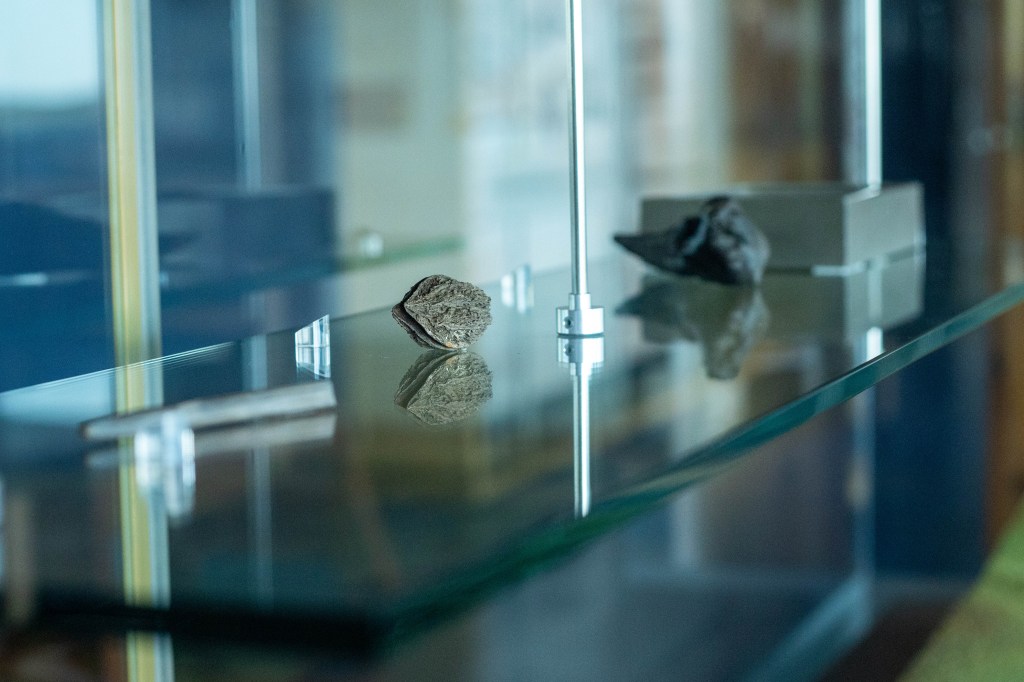
Of all the archaeological wealth unearthed at L’Anse aux Meadows, by archaeologist Anne Stine Ingstad between 1961-1969 and then by Birgitta Wallace in the 1970s, the most entrancing to me were three butternuts, products of the White walnut tree, native to the southern Gulf of St Lawrence (Maritimes), and southwest into Quebec, Ontario and New England. They were proof that the Scandinavians of L’Anse aux Meadows had sailed farther south. Exactly how much farther we cannot yet say, but I return to my rule of not underestimating our ancestors.
There are casual references in the annals of Iceland of voyages to North America as late as 1347 CE, so we can say with confidence that Greenlanders and Icelanders were sailing west for over three centuries, plenty of time to make a thorough study of the eastern seaboard. It’s a lot of history to read into a butternut, resting, modestly, behind the immaculate glass of a display case, but we must follow the evidence wherever it leads, and at least in L’Anse aux Meadows, it leads away from Vinland.
This site, unearthed on the very tip of Newfoundland’s Great Northern Peninsula, does not support the “self-sowing wheat” (probably wild rye, Elymus virginicus) “profusion of grapes” (probably wild grape, Vitis riparia) and massive salmon described in the sagas, things found more readily in the Maritimes. It also lacks all signs of Scandinavian settlement – stables for livestock, fields for crops, garbage middens overflowing with the bones of wild caught game. By all indications, L’Anse aux Meadows represents a very brief stay, its architecture geared toward the repair of ships and the rest of sailors, and not permanent occupation. The prevailing theory is that L’Anse aux Meadows was a stopover site, used by Icelanders and Greenlanders on their way to and from destinations farther south and west.
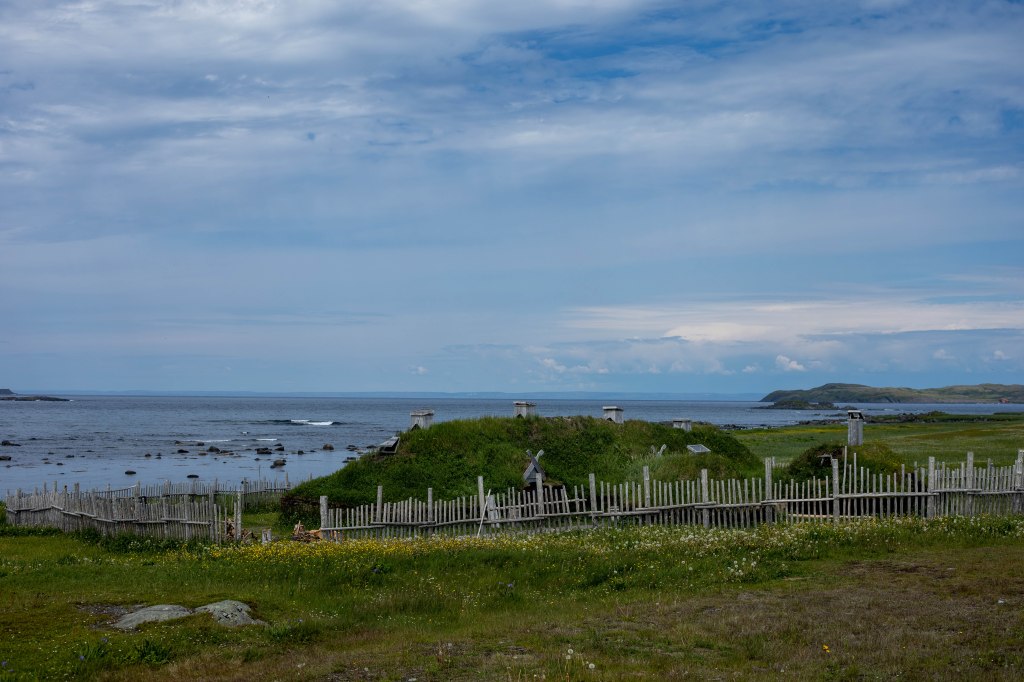
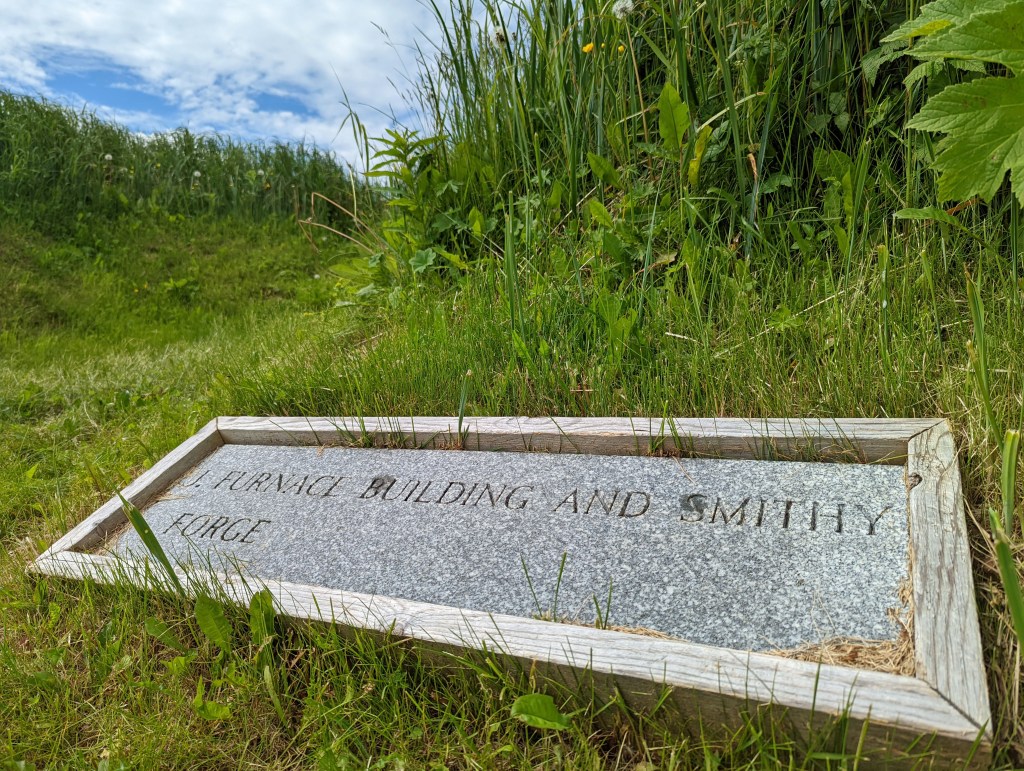
The site itself, where eight buildings once stood, is a modest place, a wooden bridge and walkways runs through the manicured grass of an opened bog, the mounds themselves no more than a few inches tall, taller, in fact, than they would have been when Helge first studied them in 1960. Their height was exaggerated, I’m told, in the reburying process, so as to be more visible. Alongside each mound is a plaque, describing the functions of each building, so far as can be guessed – hall, house, forge, repair shop.
But Parks Canada has done one better, erecting a replica village immediately beyond these mounds, populated with actors articulating the deeds of the Vikings age in thematically rough English and French. I have read the sagas twice in their entirety, and revisited their more consequential passages many times more, but to hear them on the lips of proper thespians was something else entirely. One man, playing the part of Egil Egilson – one of the saga’s navigators – retold the disastrous fifth expedition in which Erik the Red’s daughter, Freydís Eiríksdóttir, fools a crew of Greenlanders into slaughtering a crew of Icelanders, and his voice, his expression, his passion, gave me chills such as paper and ink never could.
I was warned, before stepping into this replica village, that these actors were devotees of the sagas, while the interpreters up the hill, at the discovery centre, draw their knowledge first and foremost from the archaeology. The dichotomy between these purveyors of knowledge was plain to see, another dose of flavour from this far flung corner of our collective past.
Ancestors
I chuckle when people say to me, “I’m the direct descendent of such and such a historical figure,” as if this lends them claim to a history which, only moments earlier, belonged to both of us. Such claims ignore the most fundamental rule of ancestry – that everyone ever born, regardless of society or circumstance, had two parents, four grandparents, eight great grandparents, and so on, a feat of retroactive duplication which, upon reaching the 10th century, with Bjarni Herjólfsson and Leif Erikson, leaves each of us with several billion slots on our family tree.
Of course there weren’t billions of people alive in the 10th century, a genealogical conundrum whose solution is inbreeding. If you are, for example, even vaguely of European descent, then everyone alive in Europe in the 10th century (provided they successfully reproduced) is a direct ancestor of yours. Not only that, but every one of them will show up multiple times in your family tree, filling as many of those billions of slots as is necessary for you to exist. Those hardy individuals described in the sagas, therefore – Leif Erikson, Bjarni Herjólfsson, Thorfinn Karlsefni, Gudrid Thorbjarnardottir, Erik the Red and the rest – are, necessarily, the direct ancestors of every living person of European descent.
Go back far enough, and this principle can be applied to the whole of humanity, 8 billion people, each a rendition of the same recombinant DNA. So, when I stood beneath the spectacular statue of Leif Erikson erected in L’Anse aux Meadows – the community, not the national historic site – I did so comfortable in the knowledge that, if he has any living descendants, I rank among them.
The other side of this genealogical narrative is not as well known, deriving from a migration significantly earlier than the Atlantic crossing of Scandinavian sailors. When Leif set foot in Helluland, Markland and Vinland, he was stepping into nations considerably larger and considerably older than those of Iceland or Greenland.
Exactly when the First Peoples populated Atlantic Canada is the subject of ongoing debate, but it would seem they arrived with the retreat of the glaciers, pressing north and east into New England and Atlantic Canada as early as 13,000 years ago. I have, personally, stood over the grave of a twelve year old girl at Point Armour, southern Labrador, buried more than 7,500 years ago, wrapped in skins and birch bark, and sprinkled over with red ochre. This is the oldest known elaborate gravesite in North America, excavated in 1974 and reburied shortly thereafter. Her people, known to archeologists as the Maritime Archaic, were established in Labrador at least 9,000 years ago, which means that when she was alive, her society was as ancient to her as the Roman Empire is to us. Other societies would follow the Maritime Archaic, with names like Innu, Inuit, Dorset, Beothuk, Mi’kmaq and Maliseet, most of whom are still here, standing on ancestral ground.
Given the sailing prowess of Leif and those who followed, it seems likely they encountered many or all of these nations. If Vinland was, in fact, in the Maritime, then the native peoples articulated in the sagas would have been the Mi’kmaq. There is evidence that a Beothuk women – a society then in Newfoundland – might have travelled to Iceland with these Scandinavians and become a matriarch, leaving her mitochondrial trace in living Icelanders. Contact between Greenlanders and the Inuit was so frequent that each society retains stories of the other to this day. The sagas, of course, make no effort to distinguish one nation from another, referring to First Peoples simply as “Skrælings.”
How these translocated European farmers and the First Peoples of North America got along is a difficult question to answer, and maybe a futile one, given the enormity of time in question. Every encounter between Viking and Skræling ends violently in the sagas, but this might be a quirk of Scandinavian oral tradition, stressing things like combat and glory over trade and cultural exchange. Many scholars now believe they traded skills and knowledge at least as often as they traded blows. Words of possible Scandinavian origin in the vocabulary of modern Inuit suggest the former, whereas North American arrowheads discovered in Greenlander graves suggest the latter.
Norstead
Just east of the L’Anse aux Meadows National Historic Site, with its interpretive centre, manicured mounds and replica village, there stands Norstead, yet another replica village, likewise filled with formidable thespians on a mission of authenticity and education. There you can visit the Snorri, a replica knǫrr roughly identical to the one which conveyed Bjarni and Leif to North America in 986 CE and 1000 CE respectively. This particular ship sailed from Greenland to Newfoundland in 1976, and was parked precisely here for your viewing pleasure.
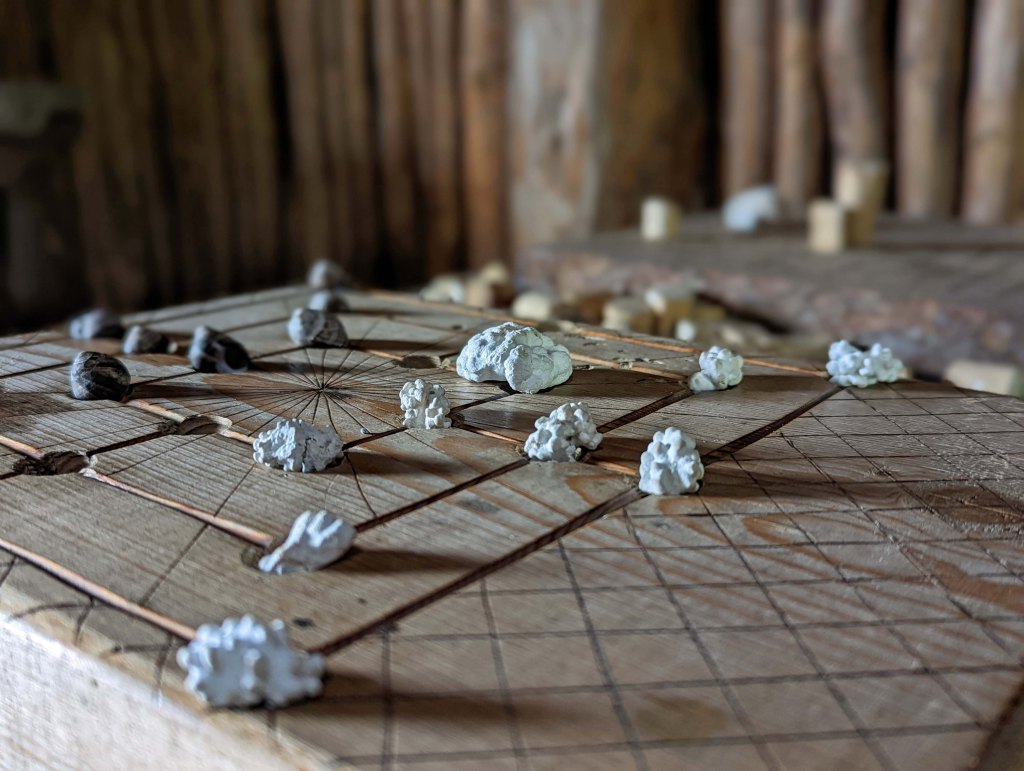
Down the Norstead walkways are upright stone murals imbued with runes, the alphabet used in most Germanic languages (English included) before their replacement with the Latin alphabet you’re presently reading. People in proper Scandinavian clothes displayed the sowing style of the Greenlanders, the forging of iron tools and weapons, the longhouses for feasting and sleep, even the boardgames to which Greenlanders were partial. You can even sit in the chieftain’s chair, draped in his sheep’s skin cloak and holding his sword, assuming he’s not using them. Oddly enough, by closest spiritual brush with the Viking Age – far from an uncomplicated chapter in human history – was a short hike immediately beyond Norstead, leading through the long grass and onto the very peak of an isolated coastal cliff, the waters of the Strait of Belle Isle turning angrily at the urging of afternoon gales, the clouds deliciously dark, surrendering the odd cavalcade of rain. The greyness of it, the tumult, the unfeeling shove of inclement weather, reminded me that the North Atlantic itself is a consequential character in this disjointed narrative. At one time, it was a frontier across which stubborn Scandinavians hopped from island to island, reshaping them along the way. By the time these people abandoned Greenland (and by extension North America) in and around 1450 CE, they weren’t quite Vikings anymore, nor were they quite Europeans. They had become an awkward branch on the cultural tree of humanity, strange, entirely unique, leaving behind only modest impressions on the shores they sought to understand. I was grateful to see at least one of those impressions at L’Anse aux Meadows, the romantic remains of a complicated people, just beyond the reach of the waves.
Zack Metcalfe is a freelance journalist, columnist and author based in Salmon Arm, BC. A version of this article was originally published with Your Local.



 The Wandering Rook
Leave a reply to Elly Cancel reply